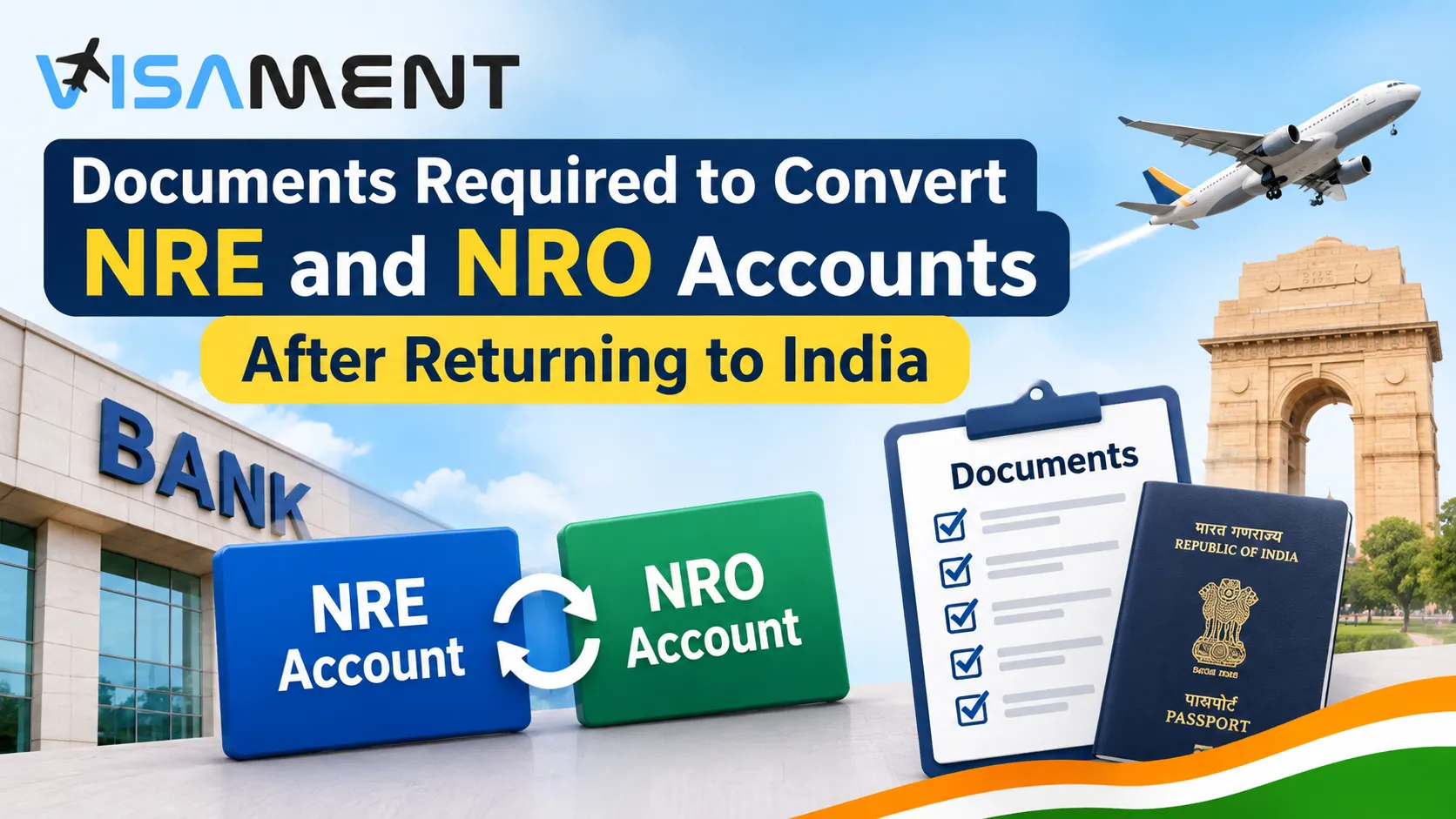
Returning to India after living abroad involves more than booking your flight and arranging your relocation. You also need to review your Indian bank accounts and update your residential status. If you maintain Non-Resident External (NRE) or Non-Resident Ordinary (NRO) accounts, you may need to convert them into resident accounts when your residential status changes under the Foreign Exchange Management Act (FEMA).
The documents required to convert NRE and NRO accounts generally include a bank conversion request form, PAN card, passport, address proof, recent photographs, and updated KYC declarations. However, the exact checklist depends on your bank and individual circumstances.
This guide explains which documents you may need, how the conversion process works, what happens to your existing balances and deposits, and the important differences between NRE and NRO account conversion.
Key Takeaways
- You generally need to redesignate NRE and NRO accounts when you return to India and change your residential status under FEMA.
- Banks may request a conversion form, PAN card, passport, Indian address proof, photographs, and updated KYC documents.
- NRE account funds may be transferred to a resident account or an eligible Resident Foreign Currency (RFC) account.
- NRO account balances are generally redesignated as resident rupee deposits.
- A temporary visit to India does not automatically require converting an NRE or NRO account.
- Document requirements and submission procedures vary between banks.
1. Why Do You Need to Convert NRE and NRO Accounts?
NRE and NRO accounts are designed for people who qualify as persons resident outside India under FEMA. When you return to India to take up employment, start a business, or stay for an uncertain period, your residential status may change.
Under RBI guidelines, an NRE account should be redesignated as a resident account, or its funds may be transferred to an eligible RFC account. An NRO account may also be redesignated as a resident rupee account when you return to India with the intention of staying for an uncertain period.
It is important to understand that a short visit to India does not automatically change your account status. The reason for your return and your residential status under FEMA matter.
Important: FEMA residential status and income-tax residential status are separate legal concepts. Do not assume that your bank account conversion date and income-tax residency date will necessarily be identical.
2. Documents Required to Convert NRE and NRO Accounts
Although the checklist varies by bank, the following documents are commonly requested when redesignating NRE and NRO accounts as resident accounts.
A. Bank Account Conversion Request Form
You will generally need to complete the bank's NRE/NRO-to-resident account conversion form or submit a written request.
The form may ask for:
- Existing NRE and NRO account numbers.
- Customer ID or relationship number.
- Personal and contact details.
- Previous overseas residential address.
- Current Indian residential address.
- Date and reason for returning to India.
- Details of other accounts and deposits maintained with the bank.
- Signatures of all relevant account holders.
Some banks provide a combined form for updating residential status across multiple banking relationships.
B. PAN Card
A copy of your Permanent Account Number (PAN) card may be required to update your customer profile and complete tax-related KYC formalities.
If your PAN details have changed or your bank records contain outdated information, you may need to update them during the conversion process.
C. Passport Copy
Your passport helps the bank verify your identity and travel history.
Depending on the bank's checklist, you may be asked to provide:
- Passport's personal information page.
- Pages containing relevant visa or residence permit details.
- Latest arrival or entry stamp, where applicable.
- Previous visa or residence permit details, if requested.
If you have renewed your passport recently, provide the latest passport details and inform the bank if your older passport contains relevant travel records.
D. Indian Residential Address Proof
After returning to India, you may need to submit proof of your current Indian residential address.
Banks may accept documents such as:
- Aadhaar card, where accepted by the bank.
- Passport showing the relevant address.
- Voter ID.
- Driving licence.
- Recent utility bill, subject to the bank's KYC rules.
- Other officially accepted address documents.
The bank may ask for additional evidence if the address on your existing KYC records is different from your current address.
E. Recent Passport-Size Photographs
Some banks require recent passport-size photographs as part of their account conversion or KYC update process.
Check the bank's photograph specifications before submitting them.
F. Overseas Address and Previous Residency Details
Your bank may ask for your previous overseas address and information about your former country of residence.
You may also need to provide supporting details about your return to India, such as your return date, employment status, or reason for relocation.
The exact supporting evidence depends on the bank's internal requirements.
G. Updated KYC and FATCA/CRS Declarations
Banks may request updated Know Your Customer (KYC) information and tax residency declarations.
You may be asked to:
- Update your current occupation and contact information.
- Declare your country or countries of tax residence.
- Provide a Tax Identification Number (TIN), where applicable.
- Submit an updated FATCA or Common Reporting Standard (CRS) declaration.
- Confirm whether your existing personal and financial information has changed.
These declarations help the bank maintain accurate customer and tax-reporting records.
H. Additional Documents for Joint Accounts
If your NRE or NRO account has joint holders, the bank may require additional documents or signatures.
Depending on the account's operating instructions, you may need:
- Signatures of all account holders.
- Updated KYC documents for joint holders.
- A revised account operating mandate.
- A declaration if a joint holder's residential status differs from yours.
Confirm the requirements with your bank before submitting the request.
3. Quick Checklist: NRE and NRO Account Conversion Documents
| Document |
Why the bank may request it |
| Account conversion form |
To formally request redesignation |
| PAN card |
Identity and tax-related verification |
| Passport copy |
Identity and travel details |
| Indian address proof |
To update your current residential address |
| Recent photographs |
KYC and account records |
| Overseas address details |
To update previous residential information |
| FATCA/CRS declaration |
To update tax residency information |
| Joint-holder documents |
To verify account holders and operating instructions |
This is a general checklist, not a universal bank requirement. Your bank may request additional documents or accept alternative proofs.
4. How to Convert Your NRE and NRO Accounts into Resident Accounts
The conversion process is generally straightforward, but the submission method and forms differ between banks.
Step 1: Inform Your Bank About Your Return to India
Contact your bank and explain that you have returned to India and need to update your residential status.
Ask whether your NRE and NRO accounts can be redesignated through one application or whether separate requests are required.
Step 2: Obtain the Required Conversion Forms
Download the relevant forms from your bank's official website or collect them from a branch.
Check whether the bank provides a specific form for:
- NRE-to-resident account conversion.
- NRO-to-resident account conversion.
- KYC and address updates.
- Tax residency declarations.
Step 3: Prepare Your Supporting Documents
Collect your PAN card, passport, Indian address proof, photographs, and any other documents requested by the bank.
Make sure your personal details are consistent across the documents. If your name, address, or passport number has changed, inform the bank.
Step 4: Submit the Conversion Request
Depending on the bank, you may be able to submit the request through:
- A bank branch in India.
- Internet banking or mobile banking.
- Registered email, where permitted.
- Courier or post, if the bank accepts physical applications.
Some banks require original documents for verification, while others accept certified or self-attested copies through approved channels.
Step 5: Complete KYC Verification
The bank will review your application and supporting documents. It may contact you if additional information or clarification is required.
Once verification is complete, the bank will update your residential status and reclassify the relevant accounts.
Step 6: Check Your Account and Deposit Details
After conversion, review your account statements and confirm that the account category, deposit status, interest treatment, and linked banking services have been updated correctly.
Ask the bank about any changes to debit cards, standing instructions, fixed deposits, recurring deposits, or linked investment accounts.
5. What Happens to NRE and NRO Funds After Conversion?
The treatment of NRE and NRO balances is not identical. Understanding the difference can help you decide how to manage your funds after returning to India.
What Happens to Your NRE Account?
NRE accounts hold eligible funds remitted from abroad or transferred from other permitted sources.
When your residential status changes, RBI guidelines provide two broad options:
- Redesignate the NRE account as a resident rupee account.
- Transfer the eligible funds to a Resident Foreign Currency (RFC) account, subject to eligibility and applicable rules.
An RFC account may be useful for eligible returning residents who want to retain foreign currency funds in India.
Discuss the available options with your bank before requesting conversion, particularly if you have substantial foreign currency balances or fixed deposits.
What Happens to Your NRO Account?
NRO accounts are generally used to manage income earned or received in India, such as rent, pension, dividends, and other permitted receipts.
When your residential status changes, the NRO account may be redesignated as a resident rupee account.
The bank will explain how your existing balance, fixed deposits, and other linked facilities will be treated after conversion.
6. What Happens to Existing Fixed Deposits?
If you have NRE or NRO fixed deposits, do not assume that they will automatically continue under the same terms after your residential status changes.
Ask your bank to explain:
- Existing deposits will be redesignated.
- The original maturity date will remain unchanged.
- The contracted interest rate will continue.
- Premature withdrawal or renewal rules will change.
- An eligible NRE deposit can be transferred to an RFC account.
RBI guidelines specifically allow certain FCNR(B) deposits to continue until maturity at the contracted interest rate after a change in residential status, if the account holder chooses this option. Their treatment is different from ordinary NRE and NRO rupee deposits.
7. Important Things to Check Before Converting Your Accounts
Before submitting your application, review the following points:
- Update all banking relationships: Inform the bank about your residential status across savings accounts, fixed deposits, recurring deposits, and other linked relationships.
- Review joint accounts: If you share accounts with a spouse or family member, ask whether the account's operating instructions or eligibility need to change.
- Check automatic payments: Review standing instructions, loan EMIs, subscriptions, and other automatic transactions linked to your existing accounts.
- Review linked investments: Update your residential status with relevant demat accounts, mutual fund providers, brokers, and other financial institutions separately, where required.
- Understand tax implications: Interest income and tax treatment can differ between NRE, NRO, resident, and RFC accounts. Confirm the applicable treatment with your bank or tax adviser.
- Keep copies of submitted documents: Retain your application acknowledgement and copies of the documents provided to the bank.
Conclusion
Converting NRE and NRO accounts is an important banking step when you return to India and your residential status changes under FEMA. The process generally involves submitting a conversion request, PAN details, passport copy, Indian address proof, updated KYC information, and any additional documents required by your bank.
Before submitting your application, check how your existing NRE and NRO balances, fixed deposits, joint accounts, and linked financial services will be handled. If you have substantial foreign currency savings, also explore whether an RFC account is suitable for your circumstances.
Planning the conversion carefully can help you maintain accurate banking records and manage your finances smoothly after returning to India.


 Also Want to Know About