Moving abroad for employment, business, or education is an exciting chapter in life. However, after becoming a Non-Resident Indian (NRI), it also involves important financial responsibilities back in India, one of which is ensuring your banking status is updated.
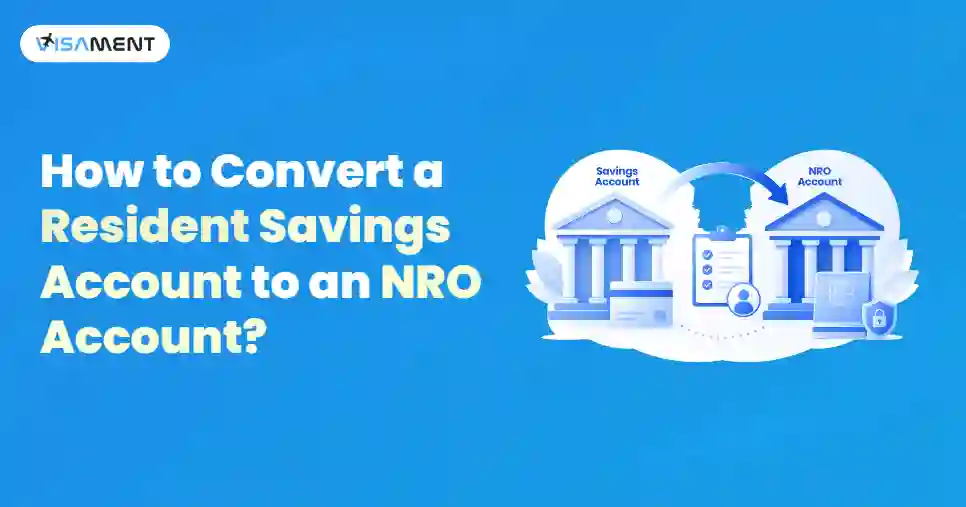
If you’ve recently become a Non-Resident Indian (NRI), you’ll need to update your resident savings account to a Non-Resident Ordinary (NRO) account to remain compliant with the Foreign Exchange Management Act, 1999 (FEMA) and Reserve Bank of India (RBI) regulations.
In this blog, we will walk you through the need for conversion, the documents required, the simple process, the consequences of not converting, and answers to frequently asked questions which are asked by NRIs.
Quick Overview: Resident Savings Account to NRO Account
- Resident savings accounts are only for individuals classified as residents under FEMA.
- After becoming an NRI, notify your bank to convert your resident savings account to an NRO account.
- There is no specified deadline from the RBI for conversion, but you should act promptly.
- Continuing to operate a resident savings account after becoming an NRI may violate FEMA rules.
Why Should You Convert Your Resident Savings Account?
When your residential status changes to non-resident, your banking relationship must reflect this change.
Here’s why you should convert your account:
- Following all the FEMA and RBI regulations prevents potential legal issues.
- It allows you to manage your income generated in India smoothly.
- It helps you avoid complications during KYC reviews and banking audits.
- Proper account management ensures easy financial handling of income from properties, pensions, and investments.
Updating your account helps you to apply for the regulatory framework for your transaction.
How to Convert Your Residential Savings Account to an NRO Account?
Converting your residential savings account is a simple process. However, the requirements can be different from one bank to another. Most banks in India offer both offline and online processes for converting a resident account to an NRO account.
Here are the steps mentioned below that will help you to convert your resident savings account to an NRO account easily:
Step 1: Inform your Bank About Your Residential Status Change
The first step is to inform your bank about the change in your residential status, as you become an NRI under the FEMA regulations.
Most of the individuals also continue to use their resident savings account after moving to a foreign country, as they think that their bank will automatically update their residential status. This is not correct; you need to inform the bank about the change in your residential status. Banks rely on customers to notify them of any change.
Also, informing the bank helps ensure a smooth process and helps you remain compliant with all RBI and FEMA regulations.
Step 2: Fill out the NRO Account Application for Conversion
You need to fill out the following information in the NRO account application for the NRO account conversion process.
Here are the details that you need to fill in your NRO account application form.
- Full name
- Current account number
- PAN Number
- Passport information
- Foreign addresses
- Indian current Address
- Date of becoming an NRI
- Employment or visa details
- Contact information
Make sure that you provide all this information in your NRO account application to avoid any delays.
Step 3: Submit the Supporting Documents
Now, you need to submit all the essential required documents for the NRO account conversion, which are mentioned below:
| Document |
Purpose |
| Valid passport |
For verification of identity |
| Visa, work permit, Residence permit |
For proof of a foreign address |
| Overseas Address Proof |
For residential verification |
| PAN Card |
For Tax compliance |
| Passport-size photos |
KYC requirements |
| Existing passbook or debit card |
For verification of the account |
| Complete conversion form |
For account conversion |
Some of the banks may also request a self-declaration for confirmation of your NRI status.
Step 4: Complete the KYC
You need to complete the KYC (Know Your Customer) verification process. For this, the bank may ask you for some additional information, which you need to provide, and the verification can be completed at:
- At an Indian bank
- Through a foreign bank branch or representative office
- Through Video KYC
- By submitting notarized and attested documents
Step 5: The Bank Verifies Your Application
Once you have submitted the information and documents, your bank will review and verify all the information, such as:
- Residential status
- Identity verification
- KYC compliance
- Account details
- Eligibility for account conversion.
If there is any need for additional information, then the bank may request it from you.
Step 6: Resident Savings Account to NRO Account Conversion
Once your NRO account application has been approved, your resident account will be converted to an NRO account.
- The account number will remain the same.
- Old instructions may continue, which are subject to the bank's policies.
- The account will be subject to the RBI and FEMA guidelines, which apply to all NRIs.
Who Needs to Convert their Savings Account?
You need to convert the savings account to an NRO account if you are an Indian citizen who has moved to any foreign country.
- For employment purposes
- Business
- profession
- Higher education
- long-term assignment
- For permanent migration
- Any other purpose to stay outside India for some time period.
Also, individuals who have become NRIs under the FEMA rules should inform their bank about the change in their residential status.
Difference Between a Resident Savings Account and an NRO Account?
See the table given below to see the difference between a resident Savings account and an NRO account.
| Feature |
Resident Savings account |
NRO Account |
| Eligible Holder |
Resident Indian |
Non-resident India |
| Governing Law |
FEMA (Resident) |
FEMA (Non-resident) |
| Purpose |
For domestic banking |
To manage income earned in India |
| Currency |
Indian Rupees (INR) |
Indian Rupees (INR) |
| Indian Income |
Yes |
Yes |
| Suitable for NRIs |
No |
Yes |
Is it Important to Convert a Resident Savings Account to an NRO Account?
Yes, you need to convert your resident savings account to an NRO account once your residential status has changed under FEMA.
Most of the people assume that they can use their resident savings account after still holding citizenship, but your NRO account eligibility is determined by your residential status under FEMA.
Is There a Limit to Converting a Resident Savings Account?
This is the most common question that is asked by the NRIs: Is there any limit on the conversion of the Resident Savings Account?
The answer is simply no:
Neither FEMA nor RBI provides prescribed limits such as 30, 60, or 90 days for converting a resident savings account to an NRO account.
However, the RBI requires all its customers to inform the banks about the change in their resident savings account.
In practical terms, it means that you need to complete the conversion process as soon as possible once you become an NRI. It reduces the process and issues and helps the NRI to use the financial activities smoothly.
What is the Penalty for Not Converting an NRO Account?
There is no fixed penalty for not converting your resident account to an NRO account.
However, if you continue using your resident savings account after becoming an NRI, then it can be considered a violation of the FEMA rules and regulations, depending on the facts and possibilities of the case.
If a FEMA violation is established, then you may need to pay the following penalties, which are governed by the Foreign Exchange Management Act, 1999, and include:
- You may need to pay a penalty of 3 times the amount.
- A penalty of up to 2 lakh where the amount cannot be quantified.
- You need to pay an extra penalty of about 5000 INR every day after continuous violations of the FEMA.
The penalty for not converting an NRO account also depends on the circumstances and facts of the case according to the applicable enforcement process. Not every delayed conversion is subject to a penalty.
To avoid this, you need to inform the bank about your status change and complete the NRO account conversion process.
Common Mistakes NRIs Should Avoid While Convert Resident Account
Here are some of the common mistakes that most NRIs should avoid while applying for a resident savings account or an NRO account conversion.
- Continue using your resident savings account after becoming an NRI.
- Not informing the bank about the change in residential status.
- Not updating the KYC and foreign address information.
- Thinking that Indian citizenship allows the use of a resident savings account.
- Confused between an NRE account with NRO account.
- Ignoring the additional request for documents by your bank.
Make sure you have all the updated information, as it can help you with an easy financial transition without facing any errors or mistakes.
Final Thoughts
Conversion of a resident savings account to an NRO account is a mandatory process that you need to do after becoming an NRO. As there is no fixed deadline for the Account conversion, you should inform your bank about the change in your residential status as soon as possible to avoid penalties or complications under the FEMA guidelines.
The process for converting a resident savings account to an NRO account is very simple and easy and requires updated KYC details, proof of foreign address, and all the supporting documents. By converting your resident account to an NRO account, you can have smooth financial transactions, managing your income earned in India while following all the RBI rules and FEMA regulations.
If you send more foreign money to India, then you should consider opening an NRO account. Discuss it with your bank. Along with it, you can also open an NRO account, which will better suit your financial needs. Both the NRO and NRE accounts will help you with smooth financial management as an NRI.