Related Blogs

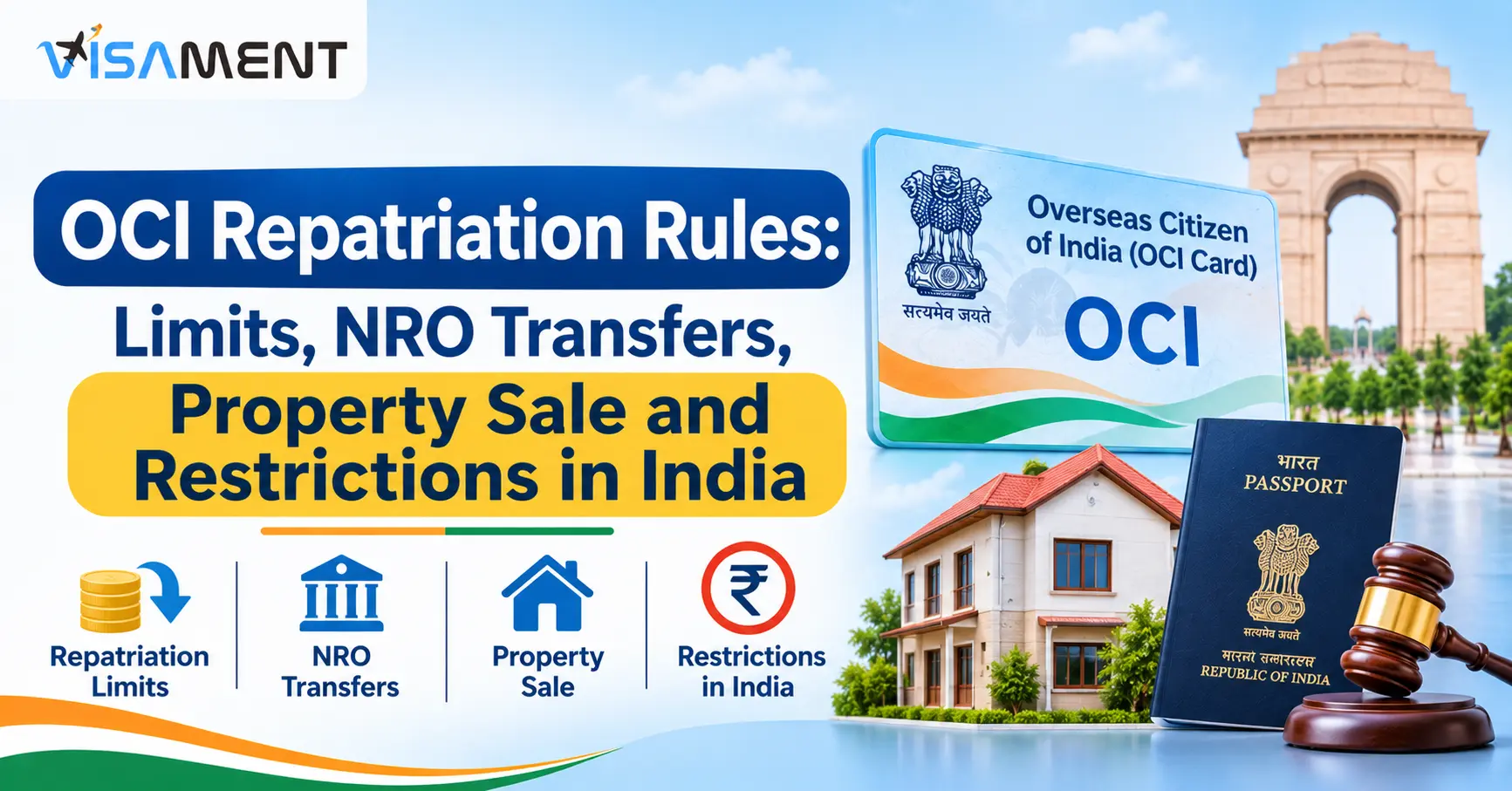
Overseas Citizens of India (OCI) cardholders can transfer eligible funds and certain asset-sale proceeds from India to overseas bank accounts, subject to the Foreign Exchange Management Act (FEMA), Reserve Bank of India (RBI) regulations, and applicable tax requirements.
Under the Foreign Exchange Management (Remittance of Assets) Regulations, 2016, an OCI cardholder who qualifies as a Person of Indian Origin (PIO) under FEMA can generally remit up to USD 1 million per financial year (April–March) through an authorised dealer bank from eligible NRO account balances, sale proceeds of assets, inherited assets, legacy, and qualifying settlements.
However, this is not a universal limit covering every type of transfer. Certain NRE balances and qualifying property-sale proceeds have separate repatriation provisions. Transactions involving inherited property, assets originally acquired as a resident of India, and remittances exceeding the prescribed limit may have additional conditions or require RBI approval.
Understanding these distinctions is important before transferring money from India to another country.
Repatriation refers to transferring money or eligible financial assets from India to a foreign country. It allows an eligible person living overseas to move funds earned, received, inherited, or generated through the sale of assets in India to an overseas bank account.
For OCI cardholders, repatriation commonly arises when they:
These transfers are governed by FEMA, 1999, and the regulations and directions issued by the RBI.
It is important to understand that having an OCI card does not mean every Indian asset can be transferred overseas without restrictions. The source of the funds, the manner in which the asset was acquired, the account type, and the individual's FEMA status all matter.
Yes. OCI cardholders can repatriate eligible funds from India, provided the transaction satisfies the applicable FEMA and RBI requirements.
The RBI includes OCI cardholders within the definition of Persons of Indian Origin (PIO) for the relevant foreign exchange regulations.
Under Regulation 4(2) of the Foreign Exchange Management (Remittance of Assets) Regulations, 2016, NRIs and PIOs can remit up to USD 1 million per financial year through an authorised dealer, subject to prescribed conditions.
The permitted sources include:
The remittance must be supported by documentary evidence. In the case of NRO account remittances, the account holder must also provide the prescribed undertaking confirming that the funds represent legitimate receivables in India and are not borrowed funds or transfers from another NRO account.
Important: The USD 1 million facility is not a blanket permission for every type of asset or transaction. Other specific FEMA provisions may provide separate routes for certain eligible investments and property-sale proceeds.
Have questions? Our experts guide you through every step of the OCI Card Service– no confusion, no delays.
Consult an Expert TodayThe USD 1 million annual remittance facility is one of the most important rules for OCI cardholders who want to transfer money from India.
Under the RBI framework, eligible NRIs and PIOs, including OCI cardholders, may remit up to USD 1 million per financial year from specified sources.
| Source of funds | Treatment |
|---|---|
| Eligible NRO account balances | Covered by the USD 1 million facility |
| Sale proceeds of eligible assets | Covered by the facility, subject to other specific rules |
| Inherited assets | Covered, subject to documentary evidence |
| Legacy received in India | Covered, subject to eligibility |
| Qualifying settlement after the settlor's death | Covered, subject to original settlement deed and other conditions |
| Eligible current income | Separate remittance treatment applies |
| Qualifying property purchased using foreign exchange | May qualify under a separate property-sale repatriation route |
Yes. The financial year in India runs from April 1 to March 31.
For example, if an eligible OCI cardholder remits USD 400,000 under this facility between April 2026 and March 2027, the remaining available amount under the annual ceiling would generally be USD 600,000 for that financial year, subject to the applicable eligibility and transaction rules.
The annual ceiling does not automatically carry forward to the next financial year.
Yes, in certain circumstances, but the individual cannot simply exceed the permitted limit without following the applicable regulatory process.
Under Regulation 7 of the Remittance of Assets Regulations, prior RBI permission is required for remittances exceeding USD 1 million per financial year in the specified categories, including:
The RBI may consider an application and impose conditions. Approval should not be assumed.
OCI cardholders living outside India may maintain eligible NRE and NRO accounts in India.
However, these accounts have different repatriation rules.
A Non-Resident External (NRE) account is designed to hold eligible foreign earnings converted into Indian rupees.
Its main repatriation features include:
The USD 1 million NRO remittance facility is not the general limit for eligible NRE balances.
A Non-Resident Ordinary (NRO) account is generally used to manage Indian income and other legitimate rupee receipts.
Examples include:
The main restrictions include:
| Particulars | NRE Account | NRO Account |
|---|---|---|
| Main purpose | Holding eligible overseas earnings in India | Managing Indian income and receipts |
| Principal repatriation | Generally freely repatriable | Subject to applicable conditions |
| Interest repatriation | Generally freely repatriable | Permitted after applicable tax compliance |
| Interest taxation in India | Generally exempt if eligibility conditions are met | Taxable |
| USD 1 million facility | Not generally applicable to eligible NRE balances | Applicable to eligible balances and specified assets |
| Transfer to another account | Eligible NRE transfers permitted | NRO to NRE transfer permitted within prescribed facility |
Choosing the correct account and understanding the source of money can help avoid unnecessary delays during repatriation.
Property transactions are among the most important areas of repatriation for OCI cardholders.
An OCI cardholder may sell eligible immovable property in India and transfer the sale proceeds overseas. However, the permitted route depends on how the property was acquired and how the purchase consideration was paid.
Under the applicable FEMA (Non-Debt Instruments) Rules, an NRI or OCI can generally repatriate eligible sale proceeds of immovable property other than agricultural land, plantation property, or farmhouses, provided:
The amount eligible for repatriation is subject to the applicable acquisition and payment conditions. It should not automatically be treated as permission to remit the entire sale value regardless of how the property was financed.
If an OCI cardholder acquired property using Indian rupee funds or while resident in India, the sale proceeds may need to be remitted under the USD 1 million Remittance of Assets facility, provided the transaction falls within its permitted categories.
Property inherited by an OCI cardholder may also be eligible for repatriation, but the process depends on the deceased owner's status, the original acquisition of the property, the applicable FEMA provision, and supporting inheritance documents.
An asset acquired and held under Section 6(5) of FEMA requires particular attention. A person or successor covered by that provision cannot automatically repatriate the sale proceeds under the separate property-sale route without RBI permission. The available remittance facilities under the Remittance of Assets Regulations must be considered.
Important: Agricultural land, plantation property, and farmhouses have separate acquisition and transfer restrictions. Do not assume that the rules for ordinary residential property apply to these categories.
OCI cardholders may receive money, residential property, or other assets through inheritance from relatives or family members in India.
FEMA provides a specific remittance facility for eligible inherited and legacy assets.
The USD 1 million facility may be used for eligible assets acquired through inheritance or legacy, subject to documentary evidence.
Depending on the circumstances, the bank may request:
Yes, subject to the relevant remittance conditions, the USD 1 million annual facility, applicable tax requirements, and the bank's verification.
An application for prior RBI permission may be required under the applicable provisions. The bank should examine the transaction and guide the applicant on the appropriate regulatory process.
OCI cardholders who own property or financial investments in India may continue to receive income from those assets while living overseas.
Examples include:
The RBI distinguishes current income from capital assets and specified remittances under the USD 1 million facility.
Eligible current income can generally be remitted overseas through an authorised dealer bank after applicable taxes and supporting documentation requirements are satisfied.
This means that eligible current income should not automatically be treated as part of the USD 1 million annual facility for remittance of NRO balances and other specified assets.
However, the bank must verify the nature of the income and the supporting documents before processing the transfer.
Repatriation and taxation are two different matters.
FEMA determines whether a particular transfer is permitted, while Indian income-tax laws determine the tax treatment of the underlying income or transaction.
An OCI cardholder may need to address the following taxes:
If an OCI cardholder sells property in India, capital gains tax may apply depending on the acquisition date, holding period, cost of acquisition, applicable exemptions, and tax provisions.
The tax treatment must be calculated under the applicable Indian income-tax rules.
TDS may apply to property sales and other payments depending on the transaction and the seller's tax status.
The buyer's withholding obligations and the seller's final tax liability are separate matters.
Rental income earned from Indian property is generally taxable in India, subject to applicable deductions and tax provisions.
Interest from NRO accounts and eligible Indian investments may be taxable in India. Dividends may also attract tax and applicable withholding requirements.
The authorised dealer bank may request:
The requirement for Form 15CA or Form 15CB depends on the nature of the remittance and the applicable provisions. These forms should not be described as mandatory for every international transfer.
The documents depend on whether the money comes from an NRO account, property sale, inheritance, investments, or another eligible source.
A typical checklist includes:
The authorised dealer bank may request additional documents depending on the transaction and applicable compliance requirements.
OCI cardholders can generally initiate an eligible repatriation transaction through an authorised dealer bank in India.
The broad process is as follows:
Step 1: Identify the source of funds
Determine whether the money comes from an NRO account, property sale, inheritance, investment proceeds, or current income.
Step 2: Identify the applicable FEMA route
Check whether the transaction qualifies under the USD 1 million remittance facility, the separate NRE repatriation provisions, the property-sale provisions, or another permitted route.
Step 3: Arrange the supporting documents
Collect bank statements, property documents, inheritance evidence, tax records, and other supporting paperwork.
Step 4: Complete applicable tax requirements
Calculate and pay applicable taxes. Obtain the necessary tax certificates and declarations.
Step 5: Submit the remittance application
Submit the application and supporting documents to the authorised dealer bank.
Step 6: Bank verification
The bank reviews the source of funds, ownership, eligibility, remittance limit, tax compliance, and other regulatory requirements.
Step 7: Transfer the funds overseas
Once the bank approves the transaction, it processes the outward remittance to the beneficiary's overseas bank account.
Processing time depends on the bank's verification, documentation, and compliance requirements.
OCI cardholders may face difficulties when the source of funds or ownership documents are incomplete.
The following are common situations worth understanding.
A person who wants to remit more than USD 1 million under the specified Remittance of Assets facility may need prior RBI approval.
Missing purchase deeds, unclear ownership history, or insufficient proof of the original purchase payment may delay property-sale remittances.
The bank may not process the remittance until the applicant establishes the legal ownership and source of the inherited assets.
Unpaid taxes, missing TDS records, or incomplete tax documentation may prevent the bank from processing the transaction.
Using an account that does not match the individual's current FEMA residential status can create compliance problems.
Some assets are subject to specific acquisition, ownership, and transfer restrictions. A general remittance facility does not automatically override those restrictions.
Understanding the rules through examples can help OCI cardholders identify the applicable remittance route.
Example 1: OCI holder has ₹75 lakh in an NRO account
An eligible OCI cardholder has ₹75 lakh in an NRO account generated through legitimate Indian receipts.
The individual may generally apply to remit the eligible amount overseas under the USD 1 million annual facility, subject to the applicable documents, taxes, and bank verification.
Example 2: OCI holder sells a property purchased using NRE funds
An OCI cardholder purchased an eligible residential property using funds from an NRE account and later sells it.
The property may qualify for the separate property-sale repatriation route, subject to FEMA acquisition and payment conditions and the two-residential-property restriction.
Example 3: OCI holder inherits property from parents
An OCI cardholder inherits a residential property from a parent living in India.
After selling the property, the individual may be eligible to remit the sale proceeds under the applicable inheritance and remittance-of-assets provisions, subject to ownership evidence, taxes, and the relevant annual limit.
Example 4: OCI holder receives monthly rental income
An OCI cardholder owns an apartment in India and receives monthly rent.
The eligible rental income can generally be remitted overseas after addressing applicable Indian tax and bank documentation requirements.
Example 5: OCI holder wants to transfer USD 1.5 million from eligible inherited assets
The individual wants to transfer USD 1.5 million from inherited assets in a single financial year.
The standard USD 1 million facility does not automatically cover the full amount. The individual may need to seek prior RBI permission for the excess amount under the applicable provisions.
OCI cardholders can transfer eligible money and asset-sale proceeds from India to overseas accounts, but repatriation is governed by specific FEMA and RBI regulations.
The USD 1 million annual facility, NRE and NRO account rules, inherited asset provisions, and residential property-sale restrictions are particularly important to understand before initiating a transfer.
The correct repatriation route depends on how the funds were generated, how the assets were acquired, the individual's FEMA status, and the applicable tax obligations.
Before making a large transfer, OCI cardholders should consult their authorised dealer bank and, where necessary, a qualified FEMA or tax professional to confirm the applicable permissions and documentation.
These are particularly important because this article discusses financial regulations.
Yes. OCI cardholders can transfer eligible funds overseas under FEMA and RBI regulations. The applicable rules depend on the source of money, account type, asset ownership, and transaction category.
The general remittance facility for eligible NRO balances and specified assets is USD 1 million per financial year, subject to applicable conditions. Certain other transactions have separate repatriation provisions.
Yes, potentially. The amount must fall within the applicable annual USD 1 million facility, and the account holder must meet the eligibility, source-of-funds, tax, and documentation requirements.
Yes, subject to the property acquisition method, original payment source, ownership history, property category, tax compliance, and applicable FEMA rules.
Yes. Eligible inherited money and assets can be remitted under the applicable provisions, generally within the USD 1 million annual facility, subject to supporting documentation.
No. NRO balances are subject to applicable repatriation restrictions. Eligible balances may be remitted under the USD 1 million facility, while eligible current income has separate treatment.
Yes. An eligible NRO-to-NRE transfer is permitted within the prescribed USD 1 million facility and applicable FEMA conditions.
The act of transferring money overseas and the tax liability on the underlying income or asset are separate matters. Applicable Indian taxes must be addressed before the authorised dealer processes the remittance.
Yes, in certain cases, subject to prior RBI permission under the applicable provisions. Approval is not automatic.
Yes. Eligible rental income can generally be remitted overseas after applicable Indian taxes and bank documentation requirements are met.
Agricultural land is subject to separate restrictions under FEMA. The ordinary residential-property repatriation route does not apply automatically. The specific ownership and acquisition history must be examined.
No. OCI status provides eligibility under certain FEMA provisions but does not remove the applicable restrictions, annual limits, tax requirements, or documentation obligations.
Vipul Jain is the Co-Founder of Visament, a trusted platform dedicated to simplifying Indian immigration, consular, and NRI services for applicants across the globe. With extensive expertise in OCI cards, Indian passport services, visa assistance, apostille and document legalization,... See Full Bio

Talk to our documentation experts for free guidance on your application.

When you visit a website, it may store data about you using cookies and similar technologies. Cookies can be important for the basic operations of the website and for other purposes. You get the option of deactivating certain types of cookies, even so, doing that may affect your experience on the website.
It is required to permit the basic functionality of the website. You may not disable necessary cookies.
Used to provide advertising that matches you and your interests. May also be used to restrict the number of times you see an advertisement and estimate the effectiveness of an advertising campaign. The advertising networks place them after obtaining the operator's permission.
Permits the website to recognize the choices you make (like your username, language, or the region you are in). Also provides more personalized and enhanced features.
Aid the website operator to determine how the website performs, how visitors interact with the site, and whether there are any technical issues.