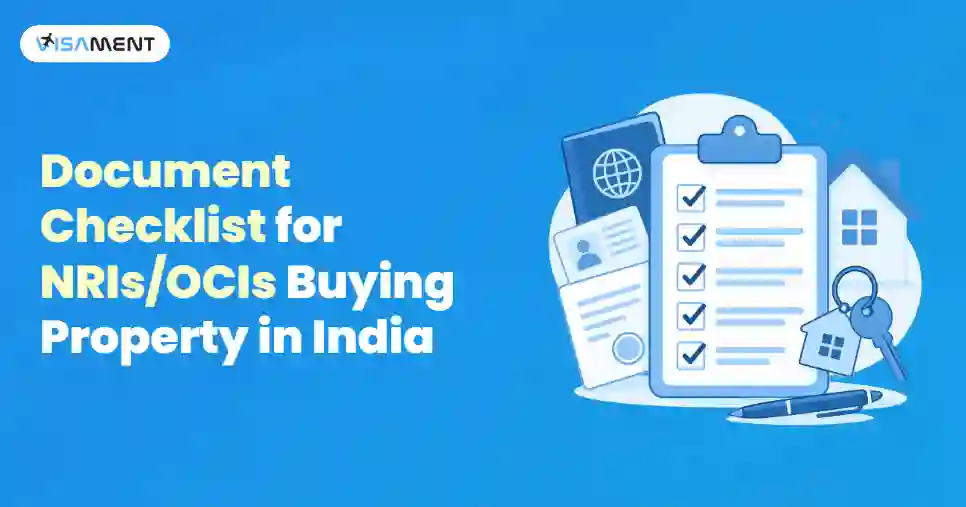
An NRI or OCI cardholder buying a residential or commercial property in India needs many more documents than a passport or proof of funds.
The document checklist for NRIs/OCIs buying property depends on the registration, state, financial, and property processes. You may also need identity documents, PAN, banking records, a power of attorney, or additional verified property documents.
These are the important NRI/OCI documents you need to provide when purchasing property in India. In this blog, we will cover a detailed document checklist for NRIs/OCIs buying property and what you should remember before buying a home, plot, apartment, or commercial building in India. We'll also cover the documentation you need to provide before purchasing the property or signing the sale deed.
Key Takeaways
- OCI/NRI property purchase documents should include common identity documents such as a PAN card, address proofs, and transaction records.
- OCI cardholders should provide a valid foreign passport with all the mandatory OCI documents.
- NRIs and OCIs cannot purchase any farming, plantation, or agricultural land in India.
- NRIs and OCIs should independently verify encumbrances, approvals, tax records, and ownership.
- Through a Power of Attorney, you can process a property purchase remotely, but it must meet execution requirements.
- Make property purchase payments only through valid, authorized banking channels.
- Check your registration requirements, as they may vary by state, property type, and local sub-registrar's office.
Documents Required for NRIs/OCIs' property purchase in India
Here is the list of documents all NRIs and OCIs must provide before buying a property in India.
Personal and identification documents
If you are an NRI or an OCI cardholder and want to purchase a property in India, you must provide the following personal and identification documents, which are general eligibility requirements before purchase.
Document requirements may differ for NRIs and OCI cardholders with a foreign passport.
- NRIs must provide a valid Indian passport for property purchase documents in India.
- OCI property purchase documents include a valid foreign passport, a common travel document, and a primary document.
- The OCI card is issued to foreign nationals of Indian origin for travel and identification purposes.
- You need to submit a valid PAN card, which is required for financial and tax-related needs.
- Gather proof of your Indian address, such as a utility bill, bank statement, or government-issued ID.
- Provide proof of your overseas address, such as a utility bill, bank statement, or government-issued ID.
- Two recently taken passport-size photos for the banking, registration, and power of attorney formalities.
- Name change or marriage documents.
The OCI card is a separate document from the Indian passport. An OCI cardholder is not an Indian citizen, so you need separate documents for OCI property purchases and NRI property purchases in India.
For documents required from a foreign country, you must notarise, apostille, or attest them before using them for a legal property purchase. Document requirements also depend on the state, so check the applicable requirements before signing the paperwork for property registration.
Get Expert Help for Your OCI Card Application!
Have questions? Our experts guide you through every step of the OCI Card Application – no confusion, no delays.
Consult an Expert Today Financial and payment-related documents
All NRIs and OCIs need to manage their bank accounts and payment records properly. This is a basic document checklist for NRIs/OCIs buying property. You must follow all applicable FEMA and Reserve Bank of India rules and regulations.
Documents for the financial payments for NRI or OCI property purchase under FEMA rules are:
- Details of the NRE account, NRO account, and FCNR (B) account.
- Proof of funds or a recent bank statement.
- Inward remittance record.
- Records of the foreign exchange conversion.
- Payment receipts and transaction records.
- Documents for the loan application.
- Income-related documents.
- Salary slips, employment contracts, and income tax records.
NRI property purchase payment rules are:
- Transfer funds through banking channels via inward remittance.
- You cannot pay by cheque or with foreign currency notes.
- Before transferring funds, the buyer must confirm the requirements with the authorized bank or dealer.
- You must keep copies of the transfer, payment, receipt, or agreement advice.
Keeping these records helps ensure a smooth process and supports tax compliance, future sales, repatriation, or payment disputes.
Documents required for the NRIs /OCIs Home Loans
If you plan to purchase property in India as an NRI or OCI by taking a home loan, you must provide the following documents, depending on the lender's requirements, your employment location, income type, and property type.
Below are some documents you need to submit when taking a home loan in India:
- Passport, Indian visa, or residence permit.
- OCI card is needed when applicable.
- Foreign employment contract or appointment letter.
- Latest salary slips and salary certificate.
- Bank statement.
- Foreign ITRs
- Credit bureau reports.
- Current loan details and financial commitments.
- Property documents by the seller or developer.
- Power of attorney for property purchase.
Documents for a home-loan property purchase can differ, and the bank and registration office checklists can also differ. Gather all documents, get the lender's written requirements, and confirm with the bank whether it needs a power of attorney format.
Power of Attorney for NRI/OCI for Property purchase in India
If an NRI plans to purchase a property, they can also authorize a trusted person to handle all legal stages of property registration. A Power of Attorney isn't required for everyone, but it is generally needed when the buyer can't attend the stamp duty and registration process in India.
If you are purchasing property through a power of attorney, keep these things in mind.
- Verify the identity of the principal and authorized representative.
- Check all the identities and property details.
- See the powers granted.
- Clearly sign the agreement deed/sale deed.
- Authority relating to payment, registration, possession, etc.
- Limits on the representative's authority.
Sign the property purchase documents before a notary or Indian consular officer in the relevant country of residence. You also need to have your POA attested, registered, and stamped.
Power of attorney requirements vary by state and sub-registrar office. You can also work with a property lawyer who can simplify the process, help you buy the property, confirm all requirements and conditions, and ensure the POA is valid.
OCI/NRI Property and Seller Documents to Verify
The documents for buying property in India do not depend only on the buyer. You also need to verify and review the seller's ownership and the property's legal status. For more detailed assistance, you can get help from our Visament experts, who will connect you with experienced lawyers before making a large payment.
| Document |
What to verify |
| Exisiting Title Deed |
Confirm the seller's ownership and property details |
| Previous Title Deed |
Review the chain of ownership and transfer history |
| Certificate or Search |
Check charges and registered mortgages |
| Search report |
Obtain legal verification of title deeds and ownership |
| Seller identity document |
Confirm seller's identity and authority to sell |
| Approved building plan |
Verify approval from the authority |
| Building permit |
Confirm required construction permission |
| Occupancy certificate |
Check if applicable for the completed build |
| Completion Certificate |
Verify and provide where required for the property |
| RERA verification |
Check registration and property details |
| Property tax receipts |
Confirm the payment status and outstanding dues |
| Municipal records |
Review the applicable local property records |
| Society share certificate |
Check for the cooperative housing society |
| Society NOC |
Get it if required by the society or transaction. |
| Loan or mortgage records |
Confirm the existing charges, if any, are cleared |
If an OCI or NRI buyer buys an apartment, the buyer should check all approvals for the land, ownership agreements, common areas, and society or association documents. Reviewing all seller documents helps you assess the property's documentation and legal status to confirm whether it qualifies.
NRIs Property Purchase FEMA Rules and Property Eligibility
When an NRI or OCI plans to buy property in India, you need to understand the eligibility requirements and FEMA rules. FEMA allows NRIs and OCI cardholders to buy immovable property in India, such as residential and commercial property. However, you cannot purchase agricultural and plantation land.
Under the applicable requirements, you can purchase any residential or commercial property in India. However, if you receive gifts, inherit, take joint ownership, or transact with a spouse who is neither an OCI cardholder nor an NRI, then there will be separate requirements under the applicable FEMA rules.
Note: Do not depend on any advertisements or sale agreement in the property description. First, have a verified lawyer check the property and confirm the applicable rules and restrictions for purchasing property in India.
For more details on FEMA eligibility and NRI property purchase payment rules, visit the official portal to review property rights and get a document checklist for NRIs/OCIs buying property.
OCI/NRI Property Registration Documents
NRI/OCI property registration documents can vary by state, transaction value, property type, and registration process. So check the document requirements with your authorized officer.
Here is the list of documents that you commonly need to provide:
- Identity documents for the buyers and sellers.
- OCI and passport documents.
- Tax and PAN-related documents.
- Current address proof
- Executed sale deed or agreement.
- Provide proof of payment for stamp duty and registration fees.
- Executed power of attorney if a representative is signing.
- Loan or bank documentation
- Source of funds and proof of payments
- Passport-size photo for biometric verification
Confirm the NRI property purchase checklist with your jurisdictional sub-registrar office, as different documents may be required depending on the NRI property registration documents before the registration appointment in the same state.
Final NRI/OCI Property Purchase Verification Checklist
Before finalizing the amount or transferring the agreement, check whether you have the following document checklist for NRIs/OCIs buying property in India.
- OCI and passport details match and are correct.
- Make sure your PAN and address details match the transaction records.
- The property complies with applicable FEMA rules.
- Verify the seller's identity and ownership.
- Receive the title chain and insurance records.
- Construction approvals and occupancy-related documents.
- Review property tax and municipal records.
- Confirm stamp duty and registration.
- Copies of the signed documents and payment records.
- Sale agreement and sale deed received by the lawyer.
Do not assume that verification of property documents by a broker, developer, seller, or bank, or by the registration office, covers the entire transaction. You also need to review the legal requirements independently and verify all high-value property purchase transactions in India.
Conclusion
If you are considering buying property in India as an NRI or OCI cardholder, you must provide all applicable documents required for property purchase and registration under the applicable FEMA rules. During the property transaction, buyers need to prepare documents such as PAN, banking records, and power of attorney documentation, and verify the seller's taxes, property ownership, registration requirements, and approvals.
Before buying NRI/OCI property in India, you need to review the requirements under FEMA rules and the state process. If you need help with an NRI/OCI property purchase, you can work with our experts, and we will support you with documentation review, legal verification, and customized tax advice.


 Also Want to Know About