Related Blogs

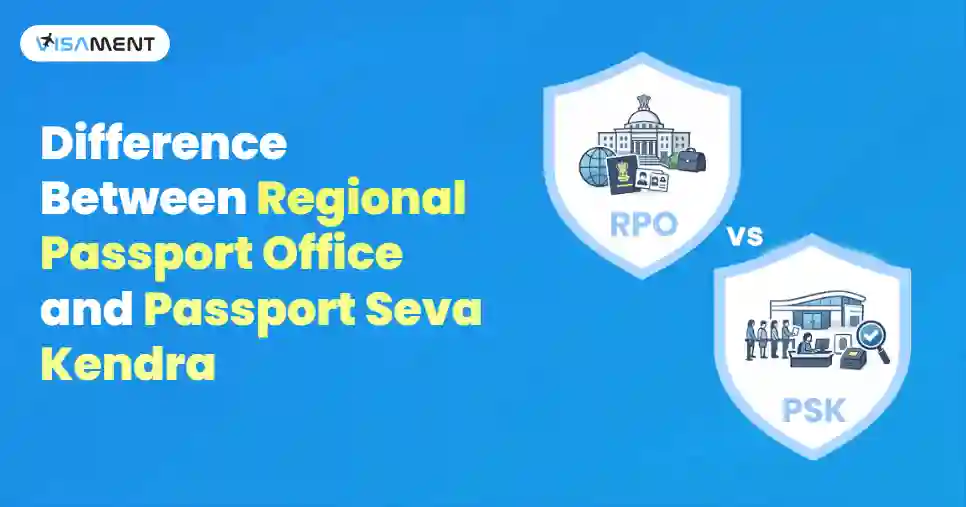
For the application for an Indian passport, you must know the difference between the Regional Passport Office (RPO) and Passport Seva Kendra (PSK). Both of these entities work together but serve different purposes in issuing Indian passports. Both of them work under the Ministry of External Affairs.
In this guide, we have compared the Regional Passport office vs Passport Seva Kendra. Read this blog till the end to gain more clarity about their roles so that you can decide which one to visit for a passport application.
| Feature | Regional Passport Office (RPO) | Passport Seva Kendra (PSK) |
|---|---|---|
| Full Form | Regional Passport Office | Passport Seva Kendra |
| Role | It has administrative authority for issuing passports | It is the front-end centre for the passport application process |
| Application Submission | Directly not allowed (except for special cases) | Yes |
| Operated By | Ministry of External Affairs (Government of India) | Private Partner (TCS) under the PPP model |
| Final Approval | Yes | No |
| Appointment Requirement | Required (Through Passport Seva Portal) | Required |
| Passport Printing & Dispatch | Yes | No |
The RPO full form in passport application is Regional Passport Office (RPO), and it is the main government authority that verifies, approves, and issues Indian Passports. It handles the entire process, including police verification, final approval, and passport dispatch.
RPO operates under the Ministry of External Affairs, and it has jurisdiction over specific regions in India. One RPO governs multiple PSKs in its jurisdiction.
RPOs handle:
The PSK full form in passport application is Passport Seva Kendra, and it is a service centre where the applicants go to submit their passport applications, complete initial verification, and complete biometrics. For all passport applicants, they are considered the first point of contact. PSKs operate under the Passport Seva Project, a PPP (Public-Private Partnership) between the Ministry of External Affairs and Tata Consultancy Services (TCS).
Passport Seva Kendras are designed to:
Apart from these full-service PSKs, the government has also set up smaller centres in Tier 2 and Tier 3 towns to increase accessibility:
These are the smaller evolutions of the standard PSKs, and they operate under the jurisdiction of an RPO. The services they offer are similar to the PSKs but with fewer appointment slots and counters.
POPSKs are set up within India Post Offices, and they extend the passport services to rural and semi-urban areas. The process is the same as that of the PSKs, and they operate under the Passport Seva Project.
| Criteria | RPO (Regional Passport Office) | PSK (Passport Seva Kendra) |
|---|---|---|
| Public Access | Restricted (only for special cases/escalations) | Open for every applicant with an advanced appointment |
| Main Function | Administers passport issuance and approval | Processes the passport applications at the front-end |
| Biometric Collection | No | Yes |
| Document Verification | Final Review | Preliminary Verification |
| Passport Issuance | Yes | No |
| Appointment Needed | Yes (only for special cases or escalations) | Yes (for all the new applicants) |
| Run By | Ministry of External Affairs (Government of India) | TCS under the supervision of MEA |
At PSK, you start with your passport journey, such as submitting documents and biometrics, and get your application started. Then this application is sent to the RPO, which approves the request after performing final checks and takes care of the passport printing and dispatch. In short, PSK is the processing centre, and RPO is the final authority for passport issuance.
Here is how they work together and their roles complement each other:
 Also Want to Know About Passport Surrender Rejection Reasons and Fixes? Check Now!
In most of the cases, it is best to visit a Passport Seva Kendra because it is the designated centre for all the standard passport services. You can apply for a new indian passport, renewal, reissuance, change of address, and updating any personal details.
The appointments for both of them are booked through the Passport Seva Portal.
You should visit a Regional Passport Office (RPO) only in special situations, such as:
NOTE: Generally, Walk-ins are not allowed at RPOs unless you have made a prior appointment or you have been specifically asked to appear.
To sum up the blog and the difference between the RPO and PSK, the Regional Passport Office is a main administrative body that issues and approves passports. While the Passport Seva Kendra is the front-facing centre from where you can start your application. To remember their difference, PSK processes the documents, and RPO finalises the application and issues the passport.
If you prefer taking expert assistance, then you can visit the Visament's website. We have a team of professionals who can help you with the passport application process while maintaining regulations and ensuring compliance.
No, PSK does not have the authority to issue your passports. It just collects your application and sends it to the RPO for final processing and then dispatch.
No, PSKs are operated under a Public-Private Partnership between the TCS and the government of India, but they function under the Ministry of External Affairs.
No, you cannot apply directly at RPO; you have to submit the passport applications at a PSK. RPOs only take care of the escalations or special cases.
No, you need to book an appointment before visiting an RPO. For special cases or escalations, it usually requires a specific call from the office.
Most of the major cities and districts have at least one PSK, mini PSK, or Post Office PSK to make sure that it covers all the area.
The RPO conducts the final approval of the passport applications and prints the passport. PSK only takes care of the application submission and biometric processing.
Vipul Jain is the Co-Founder of Visament, a trusted platform dedicated to simplifying Indian immigration, consular, and NRI services for applicants across the globe. With extensive expertise in OCI cards, Indian passport services, visa assistance, apostille and document legalization,... See Full Bio

Talk to our documentation experts for free guidance on your application.
When you visit a website, it may store data about you using cookies and similar technologies. Cookies can be important for the basic operations of the website and for other purposes. You get the option of deactivating certain types of cookies, even so, doing that may affect your experience on the website.
It is required to permit the basic functionality of the website. You may not disable necessary cookies.
Used to provide advertising that matches you and your interests. May also be used to restrict the number of times you see an advertisement and estimate the effectiveness of an advertising campaign. The advertising networks place them after obtaining the operator's permission.
Permits the website to recognize the choices you make (like your username, language, or the region you are in). Also provides more personalized and enhanced features.
Aid the website operator to determine how the website performs, how visitors interact with the site, and whether there are any technical issues.