Related Blogs

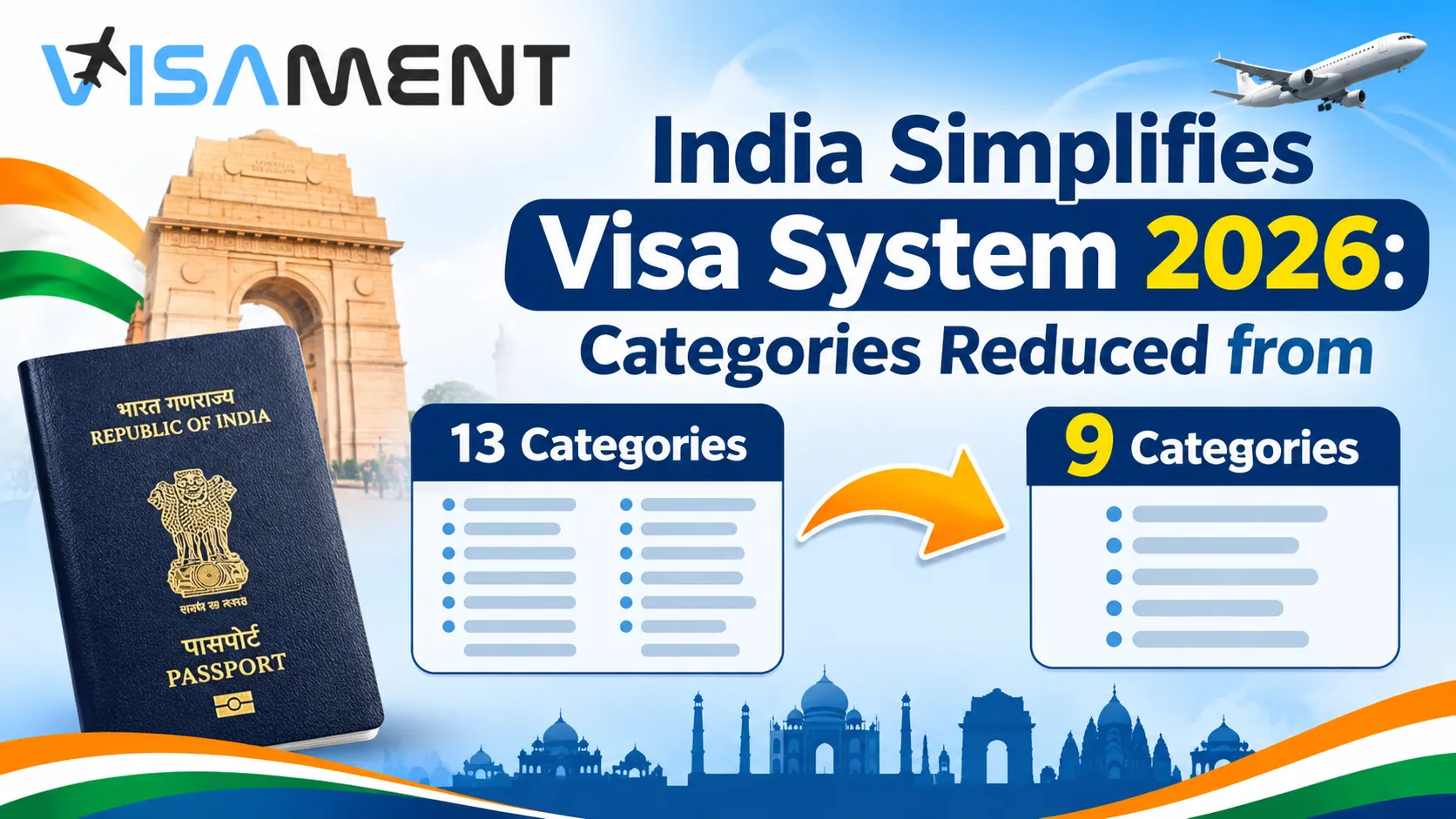
Recently, the Indian government has announced major changes to its visa system. This includes reducing the number of main visas from 13 to 9 and the number of Indian visa subcategories from 49 to 23. This announcement was made on 11 Nov 2026, showing how well India's immigration framework has been maintained; along with it, the Ministry of Home Affairs also announced that a simpler version of the visa application form will be provided for an easier, hassle-free process. As a result, the number of fields in the simplified visa application form has also been reduced by about 65-70%.
This change in the Indian visa system will help foreign nationals obtain their preferred visa for purposes such as tourism, medical treatment, business, education, research, or other needs.
One major change is that the Indian visa regime reduces the main categories and renames the tourist visa as the visitor visa; the government has also introduced new visas, V-1 and V-2, for further classifications, medical treatment, and the student and business visa categories.
In this blog, we will focus on the recent changes to India's visa system in 2026 and review the new Indian visa categories and policy changes made by the authorities and the Government of India, along with the new Indian e-visa updates for 2026.
The big change in the Indian visa reform 2026 is that the number of Indian visa categories has been reduced from 13 to 9, and subcategories from 49 to 23.
Here is the latest list of the 9 new Indian visa categories for 2026:
| Visa category | Purpose |
|---|---|
| Business visa | Investment, commercial activities, and business assignments. |
| Diplomatic visa | Foreign diplomats and their eligible dependents. |
| Work visa | Employment with Indian companies and organizations. |
| Journalist visa | Foreign journalists |
| Medical visa | For medical treatment, including AYUSH treatment, and eligible attendants. |
| Official visa | Used by foreign diplomatic government organizations for official assignments. |
| Student visa | Used for academic study, research, internships, and education. |
| Visitor visa | Used for tourism and short stays. |
| Miscellaneous visa | Used by persons of Indian origin, dependants, and other applicable categories for various purposes. |
This helps foreign nationals choose the correct visa category based on their travel purpose and makes the process easier.
Another important change in the Indian visa system is that the number of fields in the Indian visa application process in 2026 has been reduced by up to 64-70%. The Ministry of Home Affairs announced this.
In the past, foreign nationals and other Indian visa applicants had to go through a lengthy process and fill out details that are generally not important for the visa application. So, with these simplified Indian visa application forms, the process also becomes easier.
Here are the benefits of simplified Indian visa application forms.
Make sure you have provided all the correct documents for your visa application and meet all visa eligibility requirements.
Have questions? Our experts guide you through every step of the Indian eVisa Service– no confusion, no delays.
Consult an Expert TodayAnother essential India visa policy change in 2026 is that the tourist visa has been renamed the visitor visa. This visitor visa can be used for tourism activities and for a short duration of stay in India.
The visitor visa has also been divided into two sub-categories, which were recently introduced.
The V-1 visa category has been issued for foreign nationals and eligible applicants for a short visit to India for the following activities:
This V1 visa will be issued to eligible foreign nationals for 30 days, with a multiple-entry option.
If any foreign national plans to stay in India for a long period, they can apply for the V-2 visitor visa, which allows them to stay in India for a longer duration.
According to individual circumstances, it may be issued for:
The activities in the V1 visa are also included in the V2, in addition to mountaineering. Under this visa, mountaineering applicants can get entry for up to 6 months, with multiple entries.
Before applying for this visa, check all requirements on the official website and choose the applicable visitor visa category based on your needs.
For applicants seeking medical treatment, Indian authorities have also applied the India Visa Reforms 2026 to the medical visa by introducing new sub-categories M-1 to M-2. Now, treatment and the AYUSH healthcare system for applicants seeking medical attention will be easier and smoother.
Below is the table of the newly revised medical visa sub-categories.
| Visa category | Purpose |
|---|---|
| M-1 | For medical treatment other than AYUSH |
| M-2 | This visa is for the medical attendant accompanying an M-1 visa holder. |
| M-3 | For getting medical treatment under the AYUSH systems. |
| M-4 | Attendant helping the M-3 visa holder. |
Applicants who have an M-1 or M-3, along with their electronic variant, can get one-year validity with multiple entry.
The new India visa policy changes in 2026 will be useful for applicants who want to enter India to seek medical assistance for the following reasons:
Along with the M1 visa holder, one medical attendant may also accompany the visa holder to help with travel and treatment.
This has greatly improved the medical treatment process in India, and more patients now have the opportunity to come to India for medical assistance.
According to the new Indian visa system changes in 2026, the business visa has also been consolidated into two main visas, divided into 2 subcategories: B-1 and B-2 visas.
Eligibility for the Indian business visa depends on the nature and duration of your business activities in India. For the Indian business visas B-1 and B-2, you need to provide all required documents and supporting proof.
Applying for the B-1 visa means you want to stay in India for an extended period for business-related activities. These activities can be:
Under the B1 visa, new provisions have been introduced for foreign technical specialists, such as engineers, employed by Indian companies.
Here is the list of activities that apply to the foreign technical specialists:
Some eligible professionals can also obtain a production investment business visa under the B-2 category through the e-visa portal.
This new B1 visa will replace the previous B4 visa, which was used for various activities.
The Ministry of Home Affairs visa announcement has also introduced a new student visa framework by creating two sub-categories.
The S-1 category includes foreign applicants who are pursuing national school education, undergraduate courses, and postgraduate education.
The S-2 visa covers academic, research, and professional activities or courses.
These activities include:
This visa will be issued to international students admitted to Indian universities or colleges. They can get up to 5 years of vaidity to stay until the completion of their course, or up to 5 years, whichever is shorter. With this visa, you will get multiple entries, and it also helps you travel smoothly during your academic program.
India's new e-visa system now processes e-visas via the Electronic Travel Authorization (ETA) under 13 visa subcategories.
This Indian e-visa system is available to nationals of 172 countries. However, before applying, you should check the official requirements, as they may depend on your country of residence, visa type, and individual circumstances.
After introducing the Indian visa regime and reducing the main categories, the government has also announced changes to the e-visa application process and documentation for different purposes, such as medical, visitor, business, and student visas.
Highly trained workers or professionals can also get the production investment visa if they meet all the eligibility criteria. They can apply for the B2 visa through the e-visa platform.
For a smooth process, applicants should check the latest requirements and classification on the official Indian visa website and review the available facilities before applying for the e-visa.
The new India visa reforms 2026 were announced on 11 November 2026 and have significantly changed the Indian visa application process and visa system. This has also made the process easier for foreign nationals who are planning to apply for an Indian visa. However, these changes do not immediately apply to the current visa framework.
According to official sources and the government announcement, the new visa will be used under the new visa system and will take effect at the end of 2026.
In the meantime, all applicants must follow the currently applicable Indian visa rules and instructions.
Here is a list of groups of foreign nationals who will benefit most from the new Indian visa policy changes.
The new India visa application changes have made the process easier and smoother for foreign national applicants. Under the Indian visa regime, the main categories have been reduced from 13 to 9, and the subcategories from 49 to 23. Government officials and the Ministry of Home Affairs have also announced that there will be approximately a 65- 70% reduction and simplification of Indian visa application fields to make the process less complicated and easier for foreign nationals.
The major changes under the India visa reforms 2026 have been made to the Indian visitor visa (V-1 and V-2), Indian medical visa (M-1 to M-4), Indian business visa (B-1 and B-2), Indian student visa (S-1 and S-2), and Indian e-visa updates 2026.
These new changes have been announced, but they have not been implemented immediately. According to top government officials, they will take effect at the end of 2026. Applicants planning to apply for an Indian visa need to check all applicable requirements, the application process, documentation, and eligibility criteria for a smooth, error-free application.
Yes, according to the new visa policy changes, India's visa categories have been reduced from 13 to 9, and subcategories from 49 to 23.
India simplified the visa application form to make the process easier for foreign nationals, and the Ministry of Home Affairs issues it.
The new name for India's tourist visa, under the new Indian immigration system changes, is the visitor visa. It has also been divided into two subcategories: V-1 and V-2 visitor visas.
The V-1 visa is useful for a short stay in India, whereas the V-2 visitor visa provides a long stay in India.
Yes, if the M1 and M-3, along with their e-visa variants, are eligible, then the one-year medical visa will be granted under the new visa system changes.
The new Indian business visa categories are the B-1 visa, suitable for long-term stays, and the B-2 visa, which is for short-term stays.
The new student categories under the new Indian visa framework are the S1 and S2 visas. The S1 visa includes undergraduate, postgraduate, and school education, whereas the S2 visa includes research, PhDs, Internships, and other academic programs.
The new visa categories have been announced, but they have not yet started. As per the government, they will be effective by the end of 2026.
No, it has been reduced to make the process easier and to require only relevant information, not extra information.
To check the latest Indian visa application requirements, visit the official Indian visa online portal or the Ministry of Home Affairs for the latest requirements and guidelines.
Vipul Jain is the Co-Founder of Visament, a trusted platform dedicated to simplifying Indian immigration, consular, and NRI services for applicants across the globe. With extensive expertise in OCI cards, Indian passport services, visa assistance, apostille and document legalization,... See Full Bio

Talk to our documentation experts for free guidance on your application.




When you visit a website, it may store data about you using cookies and similar technologies. Cookies can be important for the basic operations of the website and for other purposes. You get the option of deactivating certain types of cookies, even so, doing that may affect your experience on the website.
It is required to permit the basic functionality of the website. You may not disable necessary cookies.
Used to provide advertising that matches you and your interests. May also be used to restrict the number of times you see an advertisement and estimate the effectiveness of an advertising campaign. The advertising networks place them after obtaining the operator's permission.
Permits the website to recognize the choices you make (like your username, language, or the region you are in). Also provides more personalized and enhanced features.
Aid the website operator to determine how the website performs, how visitors interact with the site, and whether there are any technical issues.