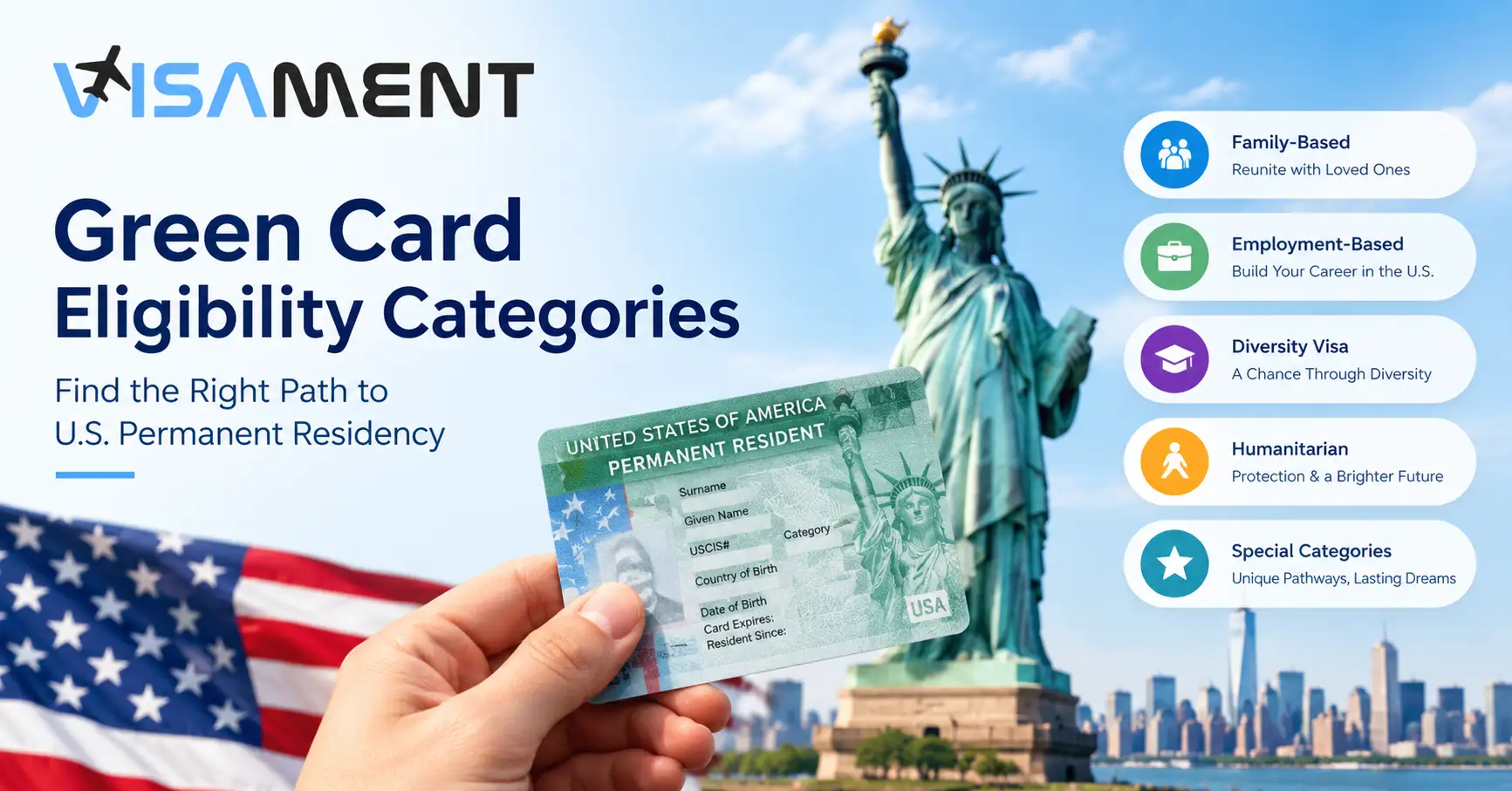
If you want to live permanently in the United States, understanding Green Card eligibility is the first step. U.S. immigration law provides several pathways to lawful permanent residence, including family sponsorship, employment, humanitarian protection, special immigrant classifications and the Diversity Visa Program. The right category depends on your circumstances, and meeting its basic requirements does not automatically guarantee approval.
This guide explains the main Green Card eligibility categories, who may qualify and where to verify the requirements before taking the next step.
Key Takeaways
- Green Card eligibility depends on meeting the requirements of a qualifying U.S. immigration category.
- Family-based immigration distinguishes between immediate relatives of U.S. citizens and family preference categories.
- Employment-based Green Cards include several categories with different qualifications and sponsorship requirements.
- Certain refugees, asylees and other qualifying individuals may pursue permanent residence through humanitarian or special immigrant pathways.
- Diversity Visa selection does not guarantee a Green Card.
- Petition approval, visa availability and final permanent residence are separate stages.
Who Is Eligible for a U.S. Green Card?
A person may qualify for a U.S. Green Card if they meet the legal requirements of an immigration category that permits permanent residence. Eligibility may depend on family relationships, professional qualifications, employment, investment, humanitarian circumstances or another specific provision of U.S. immigration law.
Applicants must also satisfy applicable filing and admissibility requirements. Depending on the category, they may need a qualifying sponsor, an approved immigrant petition or an available immigrant visa.
Importantly, having a U.S. relative, a job offer or a particular immigration status does not automatically make someone eligible. Each pathway has its own rules and exceptions.
Main Green Card Eligibility Categories
1. Family-Based Green Card Eligibility
Family-based immigration allows certain relatives of U.S. citizens and lawful permanent residents to pursue permanent residence. The qualifying relationship and the sponsor's immigration status determine which categories may be available.
Immediate relatives of U.S. citizens include eligible spouses, unmarried children under 21 and parents of U.S. citizens who are at least 21 years old. These categories are not subject to the annual numerical limits that apply to family preference categories.
Family preference categories cover specified relationships, including:
- Unmarried adult sons and daughters of U.S. citizens.
- Spouses and unmarried children of lawful permanent residents.
- Married sons and daughters of U.S. citizens.
- Brothers and sisters of U.S. citizens who meet the applicable age requirements.
Family preference categories are subject to annual numerical limits, so visa availability can depend on the applicant's category, priority date and country of chargeability.
A family relationship alone is not sufficient. For example, U.S. citizens may petition for eligible siblings, but lawful permanent residents cannot sponsor siblings through the family preference system.
Check the U.S. Department of State's family immigration guidance for the applicable relationship and sponsorship rules.
2. Employment-Based Green Card Eligibility
Employment-based immigration provides permanent residence pathways for qualifying workers, professionals, individuals with exceptional abilities, certain special immigrants and eligible investors.
The main employment-based preference categories are:
- EB-1: Certain individuals with extraordinary ability, outstanding professors or researchers, and qualifying multinational executives or managers.
- EB-2: Individuals with qualifying advanced degrees or exceptional ability. Certain applicants may qualify for a National Interest Waiver, which can waive the job-offer and labor-certification requirements when the legal criteria are met.
- EB-3: Qualifying skilled workers, professionals and other workers who meet the category's requirements.
- EB-4: Certain special immigrants who qualify under specific statutory classifications.
- EB-5: Eligible immigrant investors who meet applicable investment, job-creation and other program requirements.
The requirements differ significantly across these categories. Some employment-based applicants need a job offer and labor certification, while certain applicants may qualify to self-petition or request a waiver.
A job offer alone does not guarantee eligibility. Applicants must satisfy the requirements of the particular category, and visa availability may also affect when permanent residence can be granted.
For current employment-based immigration requirements, start with USCIS.
3. Humanitarian Green Card Eligibility
Certain people who have received humanitarian protection or meet specific humanitarian provisions may qualify for permanent residence.
Examples include:
- Refugees: Eligible refugees may apply for permanent residence after meeting the applicable statutory requirements, including the relevant physical-presence requirement.
- Asylees: Individuals granted asylum may qualify to apply for a Green Card under the rules applicable to asylees.
- Certain survivors of abuse or crime: Some individuals may qualify through provisions such as the Violence Against Women Act (VAWA) or other qualifying immigration classifications.
Other humanitarian-related statuses do not automatically lead to permanent residence. Temporary Protected Status, U non-immigrant status and T non-immigrant status each have distinct rules, and any potential Green Card route depends on additional eligibility requirements.
Because these cases can involve sensitive circumstances and complex legal questions, consult the relevant USCIS Green Card resources before applying.
4. Special Immigrant Eligibility
Some people qualify under special immigrant provisions established by U.S. law. These classifications cover specific circumstances rather than a single general eligibility test.
Depending on the applicable statutory provision, eligible groups may include certain religious workers, special immigrant juveniles and other individuals who meet narrowly defined requirements.
Applicants must identify the precise classification that applies to them and satisfy its conditions. A person's occupation, past service or personal circumstances do not automatically establish eligibility.
Review the official USCIS guidance for the relevant special immigrant category before proceeding.
5. Diversity Visa Program Eligibility
The Diversity Visa (DV) Program provides a pathway for eligible applicants from countries that meet the program's country-of-chargeability rules, subject to the applicable annual program requirements.
Eligibility generally includes meeting the program's education or qualifying work-experience criteria, along with the other requirements specified in the relevant year's official instructions.
Being selected in the Diversity Visa Lottery does not guarantee a Green Card. Selected applicants must still qualify, complete the required procedures and obtain a visa or otherwise complete the permitted process within the applicable deadline. Visa numbers are limited.
The rules, eligible countries and deadlines can vary by program year. Check the official Diversity Visa Program instructions rather than relying on old articles or unofficial announcements.
Which Green Card Category May Fit Your Situation?
The following table can help you identify which eligibility route to investigate first.
|
Your circumstances
|
Category to investigate
|
|
You are married to a U.S. citizen
|
Family-based immigration
|
|
You have a qualifying U.S. citizen or permanent resident relative
|
Family-based immigration
|
|
You have qualifying professional credentials or an employment opportunity
|
Employment-based immigration
|
|
You meet the requirements of an immigrant investor category
|
EB-5
|
|
You have qualifying refugee or asylum status
|
Humanitarian pathway
|
|
You meet the current Diversity Visa requirements
|
Diversity Visa Program
|
|
You meet a specific statutory classification
|
Special immigrant pathway
|
These are starting points, not individual eligibility determinations. The correct route depends on the details of your circumstances and the current legal requirements.
What Happens After You Identify a Potential Category?
Once you have identified a possible Green Card pathway, follow these steps:
- Check the official eligibility criteria. Confirm that your family relationship, qualifications, immigration status or other circumstances meet the rules for the category.
- Identify any required petition or sponsor. Depending on the pathway, a qualifying relative, employer or other petitioner may need to submit an immigrant petition. Some categories permit self-petitioning.
- Check visa availability. Certain categories have annual numerical limits. Review the U.S. Department of State Visa Bulletin when applicable.
- Determine the appropriate application route. Eligible applicants in the United States may be able to pursue adjustment of status through USCIS. Applicants abroad generally use consular processing for an immigrant visa, subject to their category and circumstances.
- Review the relevant forms and evidence. Requirements vary. For example, Form I-130 is used for certain family petitions, Form I-140 for many employment-based petitions, and Form I-485 for eligible applicants seeking adjustment of status.
Approval of a petition does not necessarily mean a visa is immediately available or that permanent residence has been granted. Check the USCIS Green Card resources for the applicable process.
Common Green Card Eligibility Mistakes to Avoid
Before proceeding, be aware of these common mistakes:
- Assuming every relative qualifies: U.S. immigration law permits sponsorship of specific relationships, not every family member.
- Confusing temporary status with permanent residence: Holding a temporary visa or immigration status does not automatically create a Green Card entitlement.
- Ignoring visa availability: Some approved petitions are subject to waiting periods because immigrant visas are numerically limited.
- Treating lottery selection as approval: Diversity Visa selectees must still satisfy the applicable requirements and complete the process.
- Relying on outdated information: Eligibility rules, forms, program instructions and visa availability can change.
- Overlooking admissibility requirements: Certain immigration, criminal, health-related or other circumstances may affect eligibility, depending on the applicable law and any available exceptions or waivers.
If your circumstances involve a previous immigration violation, a complicated status history or another potential inadmissibility issue, consider obtaining advice from a qualified U.S. immigration attorney or an authorized representative before filing.
Where to Verify Green Card Eligibility Requirements
The safest way to check your eligibility is to consult the official source responsible for your immigration category.
Start with USCIS Green Card eligibility guidance, then review the relevant family, employment, humanitarian or Diversity Visa requirements. Applicants pursuing immigrant visas from abroad should also consult the U.S. Department of State's immigrant visa resources.
Use current official instructions for deadlines and visa availability. If more than one pathway appears possible or your case involves complicated circumstances, seek qualified immigration advice before making a decision.
Chat to Support on WhatsApp
Stop worrying about delays. Apply now and get Indian Counsellor Services.
Chat Now Conclusion
Green Card eligibility depends on your circumstances and the specific requirements of a qualifying U.S. immigration category. Family sponsorship, employment, humanitarian provisions, special immigrant classifications and the Diversity Visa Program offer different routes to permanent residence.
Start by identifying the category most relevant to you, verify the current requirements through official government guidance and check visa availability where applicable. Understanding the distinction between eligibility, petition approval and final permanent residence can help you take the next step with more confidence.