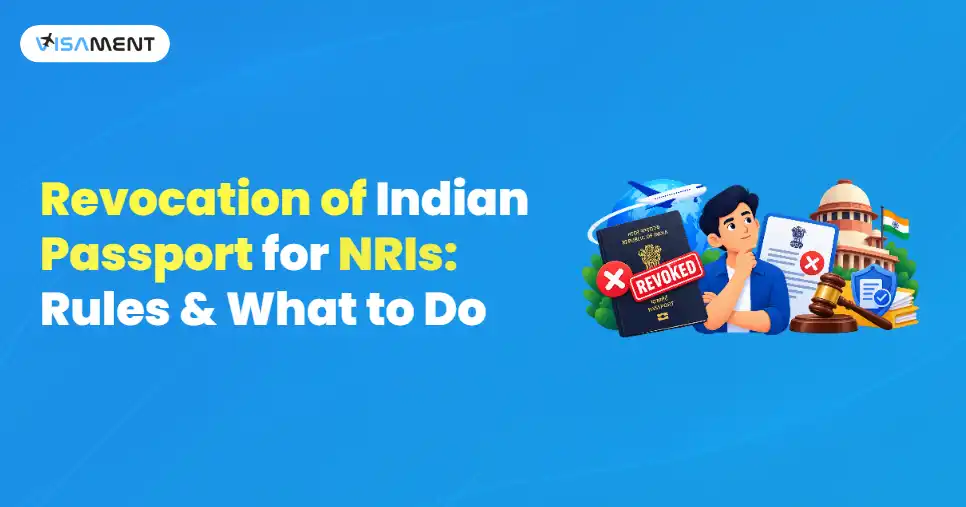
An Indian passport is a travel and identification document that NRIs use to travel and prove Indian citizenship. You can use it for travel, visa applications, and access to various Indian consular services.
Meanwhile, some NRIs face issues with passport reissue, renewal, or correction. However, there is another problem that is bigger than this, which is the revocation of Indian passports for NRIs.
This guide explains everything NRIs need to know about the Revocation of Indian Passports for NRIs, including the legal grounds for revocation, how it differs from passport impounding and cancellation, and what options are available if your passport has been revoked.
Key Takeaways
- An Indian passport can be revoked only on specific legal grounds under Section 10 of the Passports Act, 1967 and not at the discretion of the authorities.
- Passport revocation, passport impounding, and passport cancellation are different actions with separate regulations.
- The Passports Act, 1967 also governs Indian passports for NRIs.
- If your passport is revoked, it becomes invalid for international travel, but you may have the right to appeal depending on the circumstances.
- Understanding the reasons and the legal process can help you take the appropriate next steps and avoid unnecessary delays.
What is the Revocation of an Indian Passport?
Passport revocation is a legal process of withdrawing an Indian passport. The passport authority may impound or revoke an Indian passport on specified grounds under Section 10(3) of the Passports Act, 1967.
Once an Indian passport is revoked, the passport is no longer valid for use, and the holder must surrender Indian Passport without delay if it has not already been impounded.
Passport revocation is not a standard administrative process like a reissue or correction of passport details. You must follow a specific process to revoke a passport.
You will be affected if you hold a revoked Indian passport, such as:
- Affected international travel
- Verification of identity
- Immigration and visa formalities.
- You may have trouble accessing Indian consular services.
- You may also face difficulties with passport-related applications or other official procedures until the passport issue is resolved.
Having an Indian passport revoked does not cancel your Indian citizenship. Indian law has separate processes for cancelling Indian citizenship and Indian passports.
Can an NRI Indian Passport be Revoked?
Yes, the authorities can also revoke an NRI Indian passport under the Passports Act, 1967. Because an NRI holds an Indian passport, the same legal process applies, regardless of their country of residence.
If the passport authority finds that one or more legal acts are applicable. then it can revoke your Indian passport. Depending on the case, you need to contact the Indian consulate or embassy and follow their instructions for revoking an Indian passport for NRIs.
Revoking an Indian passport for NRIs is not automatic. Each Indian passport revocation is based on the applicable provision and facts.
So, after an Indian passport revocation, you must follow the process and instructions provided by the authorities before taking any legal step.
What Is the Difference Between Passport Revocation and Impounding?
The table below clearly compares passport revocation and passport impounding.
| Feature |
Passport Revocation |
Passport Impounding |
| Meaning |
Passport revocation is the legal withdrawal of a passport's validity. |
It is the process by which the Passport Authority temporarily retains the Indian passport. |
| Legal Basis |
Section 10 of the Indian Passports Act, 1967. |
Under Section 10 of the Passports Act, 1967 |
| Can you travel |
No |
No |
| Time |
Until it is resolved, or you get a new passport issued. |
It is generally temporary |
| Common reason |
Fraud, criminal proceedings, or violation of any passport condition, or a threat to national security. |
Investigation or court proceedings |
| Can you reverse it |
In some cases, you can appeal or pursue legal action. |
Yes, after the authority is lifted. |
|
Major Difference
|
A revoked passport can lose its validity. |
An impounded passport remains subject to the order and proceedings of the competent passport authority. |
What are the Common Misconceptions About Passport Revocation?
The table below lists many passport misconceptions.
| Myths |
Facts |
| Passport revocation means you will lose your Indian citizenship. |
No, if your Indian passport is revoked, you will not lose your Indian citizenship. Both have different cancellation processes under the applicable rules. |
| Every criminal case results in passport revocation |
This is not true. Each criminal case is individually evaluated under the Passports Act, 1967. |
| You can use a revoked indian passport |
No, if your Indian passport has been revoked, then you cannot use it for travel purposes. |
| NRIs are exempt from the Indian passport laws |
No, it is not true. The Indian passport laws apply to all Indian passport holders, including NRIs. |
Reasons Why an Indian Passport May Be Revoked?
An Indian passport for NRIs can be revoked only under Section 10 of the Passports Act of 1967. The authority must provide a valid reason for revoking an Indian passport, and the action must be lawful.
Wrong Possession of a Passport
If the passport authority considers that a person has wrongfully possessed an Indian passport. then they may revoke the Indian passport of an NRI. Under Section 10(3)(a), the passport authority may impound or revoke a passport if it is satisfied that the holder is in wrongful possession of the passport.
Not Providing Real Information and Submitting False Declarations
Individuals who submit any false information or incorrect declaration forms during the passport application. This can lead the passport authority to revoke the Indian passport.
It is also considered one of the most common reasons for the revocation of Indian passports for NRIs.
Here are some of the examples through which you understand it better:
- Entering incorrect information in the passport application.
- Making or providing a false declaration.
- Hiding the details in the passport application form.
Obtaining a Passport with the help of Fraudulent Documents
If a passport was obtained using wrong information, suppression of material information or other circumstances covered by Section 10, the passport authority may impound or revoke it.
Let's understand it with examples:
- Fake birth certificates
- Forged identity documents
- Wrong address proof
- Additional supporting documents
Any Conviction or Criminal Proceedings
If the passport authorities find a person involved in criminal activity or criminal proceedings, they will revoke the passport under the Passport Act.
It will include:
- Any pending criminal proceedings before an Indian court.
- A person's conviction, including for multiple offenses.
- Court-related direction affecting the validity of a passport.
Remember: a pending criminal case will not automatically lead to Indian passport revocation.
All matters for Indian passport revocation must be reviewed separately under the applicable legal provisions.
Public Interest or National Security
Under Section 10(3)(c), the passport authority may impound or revoke a passport when it considers this necessary in the interests of the sovereignty and integrity of India, the security of India, friendly relations with a foreign country, or the interests of the general public.
The authority may then take action in the interest of:
- The sovereignty and integrity of India.
- National Security
- Friendly relations with foreign countries.
- Interest of the general public.
All these decisions are governed by the provisions of the Passport Act.
Violation of Passport Conditions
A passport can also be revoked if you violate its conditions or the rules under which it is issued.
Here are examples of passport violations:
- Using your passport for wrong purposes.
- Allowing someone else to use your passport.
- Using your passport unlawfully.
- Violating the passport conditions.
What Happens if Your Passport is Revoked?
If your Indian passport is revoked, you cannot use it for travel or identification. You will also see the effect when you apply for any passport services.
Here are some consequences of a revoked Indian passport, depending on the situation in the table below.
| Consequences |
Meaning |
| Passport invalid |
You cannot use a revoked Indian passport for identification or travel. |
| International travel restrictions |
Immigration and airlines will not approve your passport for international travel. |
| Passport surrender |
The passport authority may directly ask you to surrender your passport. |
| Limited passport services |
The revocation may affect the availability of passport-related services until the matter is addressed by the competent authority.
|
| Immigration and visa formalities |
You will need to provide a visa, as some countries require one for travel. However, check the destination country's laws before traveling. |
During travel, if your passport has been revoked, contact the nearest Indian embassy or consulate for assistance and guidance related to your situation.
What is the Processing Time to Resolve Passport Revocation?
The processing time to resolve Indian passport revocation is not fixed. Many factors affect the processing time to resolve Indian passport revocation for NRIs, such as:
- The reason for the Indian passport revocation.
- Whether the applicant has filed an appeal.
- Ongoing court proceedings.
- Complex cases.
- Process of reviewing the passport authority.
Providing the correct documents and details for an Indian passport revocation can help you resolve the matter quickly and easily, without errors.
What to do When an NRI Passport is Revoked While Abroad?
If your Non-Resident Indian passport is revoked while you are abroad, stay calm and follow the steps below.
Step 1: Read the Revocation order
Read the order carefully and understand its meaning. You need to see the details such as:
- The reason the Indian passport was revoked.
- The issuing authority: Ministry of External Affairs (MEA)
- Instructions issued by the passport authority.
- Whether you can file an appeal or an explanation.
Step 2: Contact the Indian Embassy or Consulate
If you are in a foreign country and your Indian passport is revoked, contact the Indian embassy or consulate. You will get more information about Indian passport revocation for NRIs and what to do next.
Step 3: Collect Required documents
You need to gather the supporting documents for the revocation of an Indian passport, such as:
- Information on the passport
- Documents for identification
- Court orders
- The revocation order
- Communication received from the Passport Authority.
You will need to submit these documents if you are applying for a new passport or filing an appeal against the revocation of your Indian passport.
Step 4: Do not travel with a revoked Indian Passport
Traveling with a revoked Indian passport can invite serious trouble and complications. So, if your Indian passport is revoked, refrain from international travel until the issue is resolved or you get a new Indian passport.
Step 5: Get Expert Advice
If your Indian passport has been revoked, you should seek professional advice on what to do next. Expert guidance can help you resolve the issue with the right documents and a smooth, hassle-free process.
How to Appeal Against Passport Revocation?
An eligible order of the passport authority under Section 10 may be appealed under Section 11 of the Passports Act, 1967, subject to the applicable procedure and limitation period. However, Section 11 states that no appeal lies against an order made by the Central Government. If you believe your Indian passport was revoked on the wrong basis, you can file an appeal before the appellate authority, and your case will be forwarded.
The appeal process includes the following steps:
Step 1: Review the revocation order
Check the order carefully to understand the stated grounds, instructions and any applicable appeal rights or deadlines.
Step 2: Gather all the required documents
You need to collect all the documents for your Indian passport revocation, such as:
- Copy of the revocation order
- Passport details
- Proof of identity
- Supporting documents
- Court documents, if available.
Step 3: File an Appeal
You must file an appeal with the appellate authority, along with all supporting documents, within the specified time period.
Step 4: Respond to the Appeal or Proceedings
Follow the instructions issued by the appellate authority or other competent authority and provide any additional documents or explanation requested.
Step 5: Wait for Decision
The appellate authority will issue the decision based on the facts, evidence, and applicable legal provisions.
If the appellate authority reverses or modifies the order, the effect on the passport will depend on the terms of that decision and the applicable legal provisions. Do not use the passport unless the competent authority confirms that it is valid for use.
Can You Apply for a New Passport after Revocation?
Whether you can apply for a new passport after revocation depends on the reason for your Indian passport revocation and the related issues.
Here are the conditions for applying for a new passport after you meet all the eligibility requirements.
- If the ground for revocation no longer exists.
- If your appeal is successful.
- A competent court allows you to obtain a passport, if applicable.
- If the passport authority determines that all requirements have been met and are correct.
Whether a fresh passport can be issued after revocation depends on the circumstances, the reason for the revocation, the status of any appeal or proceedings, and the decision of the competent passport authority. Applicants should not assume that a fresh passport will automatically be issued after revocation.
How to Reduce the Passport Revocation Risk?
You can reduce the risk of passport revocation by following the correct processes mentioned below.
- Entering all the correct details in the passport application.
- Providing all the correct documents that are genuine and verifiable.
- Do not withhold any material facts during the passport application process.
- Follow all passport-related specifications.
- Provide all the accurate responses to any notices issued by the passport authority.
- Do not use any unauthorized third party or apps to revoke your passport.
- Do not use any wrong details or forged passports for any purpose.
- Always keep your Indian passport details updated.
By taking these precautions, you can reduce the chances of your Indian passport being revoked.
Chat to Support on Whatsapp
Stop worrying about delays. Apply now and get Indian Counsellor Services.
Chat Now Final Thoughts
The revocation of an Indian passport for NRIs is a highly serious action that can affect travel, identification, and access to Indian passport services. The Passport Authority can revoke it under the Passports Act, 1967, and you can appeal the decision.
Also, if your Indian passport is revoked, you cannot access passport services such as reissue, passport renewal, or correction of personal details. In this blog, we explain the legal reasons for Indian passport revocation and impounding, along with solutions to help you avoid them and resolve your passport revocation.
For more assistance, contact Visament experts, who can help you navigate Indian passport procedures smoothly and provide documentation and support for passport revocation, passport impounding, and passport cancellation without errors or rejection.


 Also Want to Know About