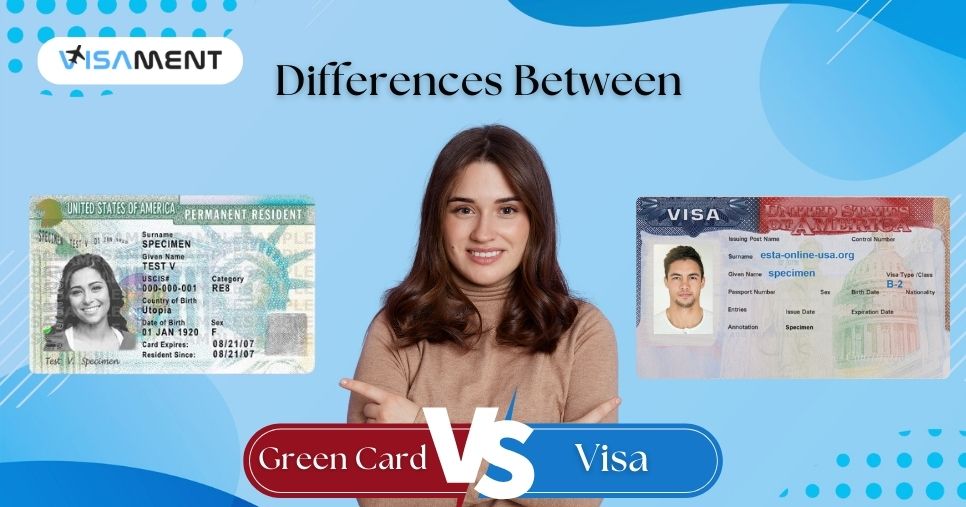
If you are planning to travel to the United States to live there permanently, then one question that must have crossed your mind, that is 'what is the difference between a green card vs visa' There is some similarity between them, which is: the green card holders generally enter the country with a visa, but not all the visa holders have or will get a green card.
In this guide, you will learn about the visas and green cards, their types, and the difference between the two. It is advisable to know about them before travelling to the United States.
Quick Overview: Green Card vs Visa
- A visa is a travel document that is obtained by individuals who need to visit the US on a temporary basis.
- A green card is considered the permanent residency card for individuals living in the United States.
- There are mainly two types of visas: immigrant and non-immigrant visas. Both of them also have many subcategories of the visa.
- The Green cards also have various types as per the requirements and the types of applicants.
What is a Visa?
A visa is a travel document that is required for individuals who want to enter the United States. They must apply for a visa through a U.S. embassy or consulate before travel. There are two types of visas that individuals can choose from, which are Immigrant visas and Non-Immigrant Visas.
What is a Green Card?
Green cards are the physical cards that represent that the holder is a permanent resident of the United States, and they can lawfully travel and work anywhere in the United States. The green card is technically a visa type that provides permanent residence. These green cards are issued after you arrive in the United States.
To be qualified for the green card, the applicant is required to have an immigrant visa already, and they have to apply through the U.S. Citizenship and Immigration Services (USCIS). The green cardholders can get citizenship after three to five years. The green cardholders need to renew their cards every 10 years.
What's the Difference Between a Green Card and a Visa?
Here is the comparison between a Green card and a visa:
| Visa |
Green Card |
| Visas are obtained before travel. They provide entry into the United States and are usually stamped in a passport. |
Green cards are only obtained after you arrive in the United States. |
| With visas, you cannot stay in the US permanently. The non-immigrant visas have a set duration of time depending on the travel reason, and will eventually expire. |
You need to obtain an immigrant visa before getting a green card. |
| The Non-immigrant visas are not generally a way to get permanent resident status. |
A green card is a physical card that shows its holder can live and work permanently within the United States. |
| Immigrant visas can start the process for permanent residential status, but they do not provide the resident status themselves. |
A green card holder can pursue citizenship in the United States. |
What are the Different Types of Visas and Green Cards?
In this section, we will discuss the different types of visas and green cards.
Types of Visas
Here are some of the most important types of U.S. Visas:
- B-1 Visa: For temporary business visitors planning to stay in the U.S. for over 90 days or those previously denied entry or a visa.
- E-1 Visa: Designed for employees and self-employed individuals who wish to live and work in the U.S. for an extended period. Valid for up to 5 years per application.
- E-2 Visa: Ideal for investors and companies that have invested, or plan to invest, in a U.S. business and transfer employees to the U.S. branch.
- H-1B Visa: For skilled professionals working temporarily for a U.S. company. One key advantage is that there are no special requirements for the sponsoring employer.
- H-2B Visa: For temporary non-agricultural workers in the U.S. This visa is quota-based and issued in limited numbers each financial year.
- I-Visa: Issued to media professionals such as journalists, editors, reporters, and broadcasters working in the United States.
- K-1 Visa: Also known as the fiancée visa, it allows foreign nationals to travel to the U.S. to marry a U.S. citizen.
- K-3 Visa: Helps foreign spouses of U.S. citizens enter the United States faster. Usually valid for 24 months with multiple-entry benefits.
- L-1 Visa: For business owners or employees transferring to a U.S. office, branch, subsidiary, or affiliated company.
- O Visa: For individuals with extraordinary abilities in fields such as arts, entertainment, sports, science, or education. Includes O-1A, O-1B, and O-2 categories.
- P Visa: Granted to athletes, artists, and entertainers performing in the U.S. individually or as part of a group. Includes P-1, P-2, and P-3 categories.
- R Visa: For members of religious communities travelling to the U.S. for temporary religious work.
Types of Green Cards
There are many categories of Green cards, and here are some of the common types of cards:
- Family-based Green Card: The close relatives of current U.S. citizens and other green card holders can apply under this category. These include the immediate family members, such as siblings, parents, children, and also widows and widowers of either the green card holders or US citizens.
- Employment-based Green Card: Specific types of workers and their immediate family members (in some cases) are provided with green cards tied to their jobs.
- Humanitarian Green Card Holders: There are certain types of individuals who are eligible to receive the green card. These include Refugees, asylum seekers, and the victims of human trafficking, crime, or abuse.
- Diversity Lottery Green Card: Every year, the government of the US randomly selects up to 50,000 people from a pool of entries it gets from the six different regions, Africa, Asia, and Oceania, and provides them a green card. The priority is given to those individuals who belong to the countries that have had little immigration to the United States in recent years.
- Longtime Resident Green Card: All the individuals who have lived in the United States physically since January 1, 1972, lawfully or unlawfully, are eligible to apply for a permanent resident card through a special process called 'Registry'. You need to follow the specific conditions to apply for a green card under this category.
Conclusion
A visa and a Green Card are both very important documents that are required for travel to the United States. For the applicants, it is important to know the difference between them. You can understand the visa vs green card from the above-mentioned information. There are various types of visas and green cards available for applicants, and you need to apply carefully as per your circumstances.
You can also get assistance from the experts, as they have many years of experience in this field. Our professionals can apply for your visa or green card, whichever you require, without you being stressed about the applications.